






Moving to Spain from UK
One Client. One Journey. One Platform.
- 1 Article Summary
- 2 Key Takeaways for UK Nationals Moving to Spain
- 3 Pros & Cons of Moving to Spain from UK
- 4 Biggest Mistakes UK Expats Make When Moving to Spain
- 5 Who Is This For / Not For: Moving to Spain from UK
- 6 Solutions for High-Net-Worth UK Nationals Moving to Spain
- 7 What Changed in 2025 for UK Nationals Moving to Spain
- 8 Hot Off the Press: Latest Updates for UK Nationals Moving to Spain
- 9 Moving to Spain from UK: Visas, Residency & Living Guide
- 10 Advantages of Moving to Spain from UK
- 11 7 Biggest Mistakes When Moving to Spain from UK
- 12 Moving to Spain from UK: Understanding Residency Options
- 13 Summary: Spain Visa Options at a Glance
- 14 Living in Spain
- 15 Lifestyle in Spain
- 16 Cost of Living in Spain for UK Expats
- 17 Schooling in Spain
- 18 Community in Spain & Expat Life in Spain
- 19 Healthcare in Spain
- 20 Best Places to Live in Spain
- 21 Taxes in Spain: Essential Guide for UK Expats
- 22 Becoming a Spanish Tax Resident
- 23 Income Tax in Spain
- 24 Dividend Tax in Spain
- 25 Capital Gains Tax in Spain
- 26 Succession Tax in Spain
- 27 Spanish Wealth Tax
- 28 Beckham Law Spain
- 29 Financial Considerations of Retirement in Spain
- 30 Finding the Best Forex Brokers in Spain
- 31 Why Choose Advice for Expats?
- 32 Frequently Asked Questions (FAQ) on Moving to Spain from UK
- 33 People Also Ask
- 34 Secure Your Financial Future in Spain
Article Summary
Moving to Spain from UK offers UK nationals sunshine, strong expat communities and excellent lifestyle value, but post-Brexit relocation requires careful planning around visas, tax residency, healthcare cover and property decisions. This guide explains how British expats can relocate to Spain confidently, avoid costly compliance mistakes and structure finances properly for long-term stability.
Key Takeaways for UK Nationals Moving to Spain
- UK nationals now require an approved long-stay visa or residency pathway to live in Spain following Brexit.
- Most applicants qualify through employment, self-employment, non-lucrative visa residency or financially independent relocation routes supported by sufficient income evidence.
- Many Spanish residency categories also require comprehensive private medical insurance with compliant Spanish healthcare coverage before approval is granted.
- Spain generally applies tax residency once individuals spend more than 183 days per year in the country, making day-count management and UK departure planning increasingly important for British expats.
- For many UK nationals, Spain offers a highly attractive combination of Mediterranean climate, established UK expat infrastructure, strong healthcare access and long-term lifestyle appeal.
- Successful relocation planning usually requires securing the correct residency route through a Spanish consulate before departure and maintaining compliant supporting documentation throughout the application process.
- The relocation process typically involves selecting the appropriate visa pathway, preparing documentation carefully, relocating physically and registering locally after arrival in Spain.
- Spain remains highly accessible for UK nationals who complete structured residency, tax and financial planning before relocation takes place.
Pros & Cons of Moving to Spain from UK
Pros
- Spain offers lower living costs than many UK regions, particularly for housing, dining out and day-to-day lifestyle expenses.
- UK expats can benefit from excellent healthcare, strong public services and well-established private medical options.
- The lifestyle includes warmer weather, Mediterranean living, strong British expat communities and excellent regional choice.
Cons
- Visa applications require careful documentation, financial evidence, healthcare cover and preparation before relocation.
- Spanish tax exposure can be higher than expected depending on your income, assets, pensions and chosen region.
- Local residency appointments, municipal registration and administrative steps can be slow if documents are incomplete or poorly prepared.
Biggest Mistakes UK Expats Make When Moving to Spain
- The first major mistake UK nationals make when moving to Spain is assuming the old pre-Brexit freedom-of-movement system still applies. Remaining in Spain beyond Schengen limits without the correct visa or residence route can create overstays, refused re-entry and long-term immigration complications.
- The second — and often most expensive — mistake is triggering Spanish tax residency before reviewing pensions, investment structures, UK property income, offshore assets and worldwide reporting obligations. Poor timing can create avoidable tax exposure, Modelo 720 reporting problems and inefficient pension taxation that become difficult to correct later. This becomes particularly serious for high-net-worth UK nationals with international assets, offshore bonds, business-sale proceeds, trusts, rental portfolios or substantial pension holdings.
- The third mistake is selecting the wrong residency route. Spain’s Non-Lucrative Visa, Digital Nomad Visa, Entrepreneur Visa and Highly Qualified Professional pathways are designed for very different applicant profiles. Choosing incorrectly can create avoidable restrictions, delays, refusals and financial inefficiencies.
- The fourth mistake is assuming healthcare access is automatic. Many UK nationals require fully compliant private medical insurance during the visa and early residency phase before public-system access becomes available. Inadequate cover can delay or weaken residency applications.
- The fifth mistake is buying property emotionally before reviewing purchase taxes, legal fees, regional tax exposure, succession implications, wealth tax rules and long-term affordability. Property decisions in Spain should always be assessed alongside residency and tax planning.
- The sixth mistake is missing the Beckham Law application window or failing to assess whether the regime could materially improve tax efficiency for qualifying executives, entrepreneurs and internationally mobile professionals.
Another major error is treating visas, tax, pensions, property and wealth planning as separate decisions instead of one coordinated relocation strategy.
The UK nationals who relocate most successfully to Spain are usually those who begin planning 6–18 months before departure, aligning UK exit, Spanish residency, pensions, tax position, healthcare and asset structure before relocation begins.
The reality is simple: Spain rewards organised, well-advised applicants and punishes under-planned relocation.
Who Is This For / Not For: Moving to Spain from UK
Who This Is For
This guide is for UK nationals seeking structured long-term residency in Spain following Brexit.
It is particularly relevant for UK retirees, remote workers, executives, entrepreneurs, families and financially independent individuals relocating to Spain for lifestyle, retirement or tax-planning reasons.
The most suitable applicants are those with stable income, healthcare cover, clear relocation objectives and a willingness to structure residency, UK pensions and tax planning correctly before departure from the UK.
Who This Is Not For
This guide is not for people expecting instant or undocumented relocation into Spain post-Brexit.
It is not suitable for UK nationals unwilling to comply with Spanish visa rules, tax reporting obligations or residency requirements.
Spain can be highly attractive financially, but it is not automatically “low tax.” UK nationals expecting guaranteed tax neutrality without proper planning may face unexpected exposure later.
Solutions for High-Net-Worth UK Nationals Moving to Spain
High-net-worth UK nationals moving to Spain require advanced relocation planning because Spanish tax residency can materially affect pensions, worldwide income, offshore assets, inheritance exposure and long-term wealth preservation.
The strongest outcomes usually depend on strategic pre-relocation structuring of pensions, investment portfolios, business interests, property holdings and remittance strategy before Spanish tax residency begins.
For affluent UK expats, timing is critical. Residency start dates, asset disposals, pension access and cross-border reporting obligations should all be aligned carefully before relocation.
This is particularly important for UK nationals with international assets, offshore bonds, trusts, business-sale proceeds, rental portfolios or multi-jurisdictional estate-planning requirements.
Spanish residency applications for HNWIs increasingly reward strong documentation, source-of-funds clarity and properly coordinated tax planning.
With proper structuring, Spain can offer long-term lifestyle value, wealth protection, estate-planning opportunities and financial stability. Without planning, the same move can create avoidable reporting complexity and tax inefficiency.
What Changed in 2025 for UK Nationals Moving to Spain
- Spain continued expanding the Digital Nomad Visa framework under the Startups Law, making remote-working residency routes significantly more mainstream for UK nationals relocating after Brexit.
- Spanish tax authorities increased scrutiny around foreign asset reporting, Modelo 720 compliance and tax residency enforcement, particularly for new arrivals with UK pensions, offshore assets and international investments.
- Spain’s residency administration continued moving toward more digitised appointment and processing systems in many regions, increasing the importance of document quality, preparation and correct sequencing.
- The UK’s shift toward residency-based inheritance tax treatment from April 2025 materially increased the importance of cross-border estate planning for UK nationals relocating long term to Spain.
- The broader shift is clear: moving to Spain is no longer simply a lifestyle move for UK nationals — it is now a coordinated residency, tax and wealth-planning exercise.
Hot Off the Press: Latest Updates for UK Nationals Moving to Spain
- High demand in coastal and UK expat-heavy regions continues tightening rental supply, making early accommodation planning increasingly important for UK nationals relocating to Spain.
- Spanish visa and residency authorities are increasingly rewarding well-prepared applicants while delaying or rejecting incomplete, inconsistent or weakly documented applications.
- Private healthcare remains the practical default for many UK nationals during the early residency phase, reinforcing the importance of compliant insurance cover before relocation.
- UK–Spain cross-border tax coordination is becoming increasingly visible in practice, particularly around pensions, residency status, offshore assets and international reporting obligations.
Bottom line: Spain remains one of the strongest relocation destinations in Europe for UK nationals — but successful relocation increasingly depends on preparation quality, financial structuring and compliance discipline before the move begins.
Moving to Spain from UK: Visas, Residency & Living Guide
Before you begin, review our comprehensive leaving the UK preparation guide covering essential visa, tax, legal and logistical steps.
Why Move to Spain? Benefits for UK Expats
For many UK nationals, Spain represents far more than a lifestyle move. It offers the opportunity to combine Mediterranean living, lower living costs, excellent healthcare and European residency with long-term retirement and financial-planning opportunities.
British expats moving to Spain from UK are often attracted by climate, healthcare quality, established expat infrastructure and the ability to achieve a stronger work-life balance than in many parts of the UK.
Spain remains one of the most popular relocation destinations for UK nationals, although post-Brexit residency now requires significantly more planning around visas, tax residency, pensions and healthcare.
With proper preparation, however, long-term Spanish residency remains highly achievable for well-organised UK applicants.
Some UK nationals also explore alternative destinations such as moving to Albania from UK, where residency rules, tax structures and living costs differ significantly from Spain.
Others compare nearby destinations such as moving to Portugal from UK, particularly where residency flexibility and tax considerations differ from Spain.
Structured relocation planning helps UK nationals coordinate visas, residency, tax residency, pensions and healthcare before leaving the UK.
Experience Life in Spain: See Why Expats Love It!
Thinking about moving to Spain from UK? Discover why thousands of British expats choose Spain for its climate, lifestyle, healthcare, lower living costs and long-term retirement opportunities. For many UK nationals, relocating to Spain is not simply about sunshine — it is about achieving a more balanced, financially sustainable and enjoyable way of life.
Moving to Spain without a properly structured UK exit plan can trigger avoidable UK tax liabilities, pension mistakes and residency problems that are expensive to reverse later.
- Avoid UK exit tax errors before departure.
- Protect pensions before transferring or accessing benefits.
- Structure tax residency correctly from day one.
- Secure cross-border tax compliance and asset protection.
Book My Free 15-Minute Exit Strategy Call.
Limited private strategy slots available each week.
Trusted by UK nationals globally.
Prefer to speak directly? Tel: +44 208 058 8937.
Email: connect@adviceforexpats.com.
Advantages of Moving to Spain from UK
For UK nationals relocating after Brexit, Spain continues offering one of the strongest combinations of climate, healthcare, lifestyle value and long-term residency appeal anywhere in Europe.
Living in Spain provides a Mediterranean lifestyle built around outdoor living, warmer weather, strong regional identity and a slower pace of life than many parts of the UK.
Some UK nationals also compare Mediterranean destinations such as moving to Italy from UK depending on tax exposure, lifestyle preferences and residency flexibility.
Lower Cost of Living: Many areas of Spain remain significantly cheaper than London and the South East, particularly for property, dining and day-to-day lifestyle expenses.
Spain also offers specialist tax incentives such as the Beckham Law for qualifying UK executives, entrepreneurs and internationally mobile professionals.
- Residency Options for UK Nationals: Spain offers several structured residency pathways including the Non-Lucrative Visa, Digital Nomad Visa and Highly Qualified Professional routes.
- World-Class Healthcare: Spain’s healthcare system consistently ranks among the strongest in Europe, supported by extensive private healthcare availability and English-speaking medical providers in many regions.
- Established Expat Communities: British expat communities across Costa del Sol, Costa Blanca, Alicante, Malaga and Valencia help many UK nationals integrate more comfortably after relocation.
-
Excellent Connectivity: Spain’s transport network and international airports provide strong connectivity with the UK and the rest of Europe.
-
Diverse Property Market: Spain offers property options ranging from affordable inland homes to luxury coastal villas, making it attractive for UK retirees, investors and second-home buyers.
-
Retirement in Spain remains highly attractive for UK nationals seeking climate, healthcare access, lower living costs and established British expat infrastructure.
Explore our guide to the best places to live in Spain for UK expats.
7 Biggest Mistakes When Moving to Spain from UK
While moving to Spain from UK can be life-changing in a positive way, the biggest risks are usually financial, tax and residency mistakes that only become visible after relocation.
Most expensive problems arise because UK nationals move first and structure later.
Spain Visa Requirements Post-Brexit: UK nationals now require the correct long-stay visa or residency route for stays beyond Schengen short-stay limits. Incorrect Schengen day-counting can create overstays, refused re-entry and long-term immigration complications.
Underestimating the Cost of Living: Spain can be significantly cheaper than parts of the UK, but regional costs vary dramatically between Madrid, Barcelona, Marbella, Valencia and inland regions.
Ignoring Spanish Tax Rules: Once you become Spanish tax resident, worldwide income, pensions, offshore assets and overseas reporting obligations may all become relevant.
Failing to Learn the Language: While many UK expat-heavy regions function comfortably in English, stronger Spanish language skills materially improve long-term integration and administration.
Choosing the Wrong Location: Property prices, taxation, healthcare access, climate and expat infrastructure vary substantially across Spain.
Not Securing Compliant Health Insurance: Comprehensive private healthcare insurance remains mandatory for many Spanish residency routes.
Not Getting Expert Help: Poorly structured residency, pensions, property purchases and tax planning can create long-term costs that are difficult and expensive to unwind later.
Moving to Spain from UK: Understanding Residency Options
For UK nationals moving to Spain from UK, selecting the correct residency route is one of the most important decisions in the relocation process.
Different visa pathways create different tax consequences, employment restrictions, renewal obligations and long-term residency outcomes.
The correct route depends heavily on your income source, pension structure, work status, healthcare arrangements and long-term objectives in Spain.
Choosing incorrectly can create avoidable restrictions, delays and financial inefficiencies later.
Up-to-date legal and residency information is published in UK government guidance on living in Spain. The European Union provides EU guidance on Brexit residence rights for UK nationals living in Spain.
Spanish Non-Lucrative Visa (For Retirees & Passive Income Earners)
The Spanish Non-Lucrative Visa is ideal for UK nationals who want to retire or live in Spain without working. This visa allows residency as long as you can prove financial independence.
Key Requirements:
- Financial proof: Minimum 400% of IPREM annually (€28,800 per year in 2024).
- Health insurance: Must have private health insurance covering all medical expenses in Spain.
- Employment restrictions: Cannot work or run a business in Spain.
- Clean criminal record: Required from all countries of residence in the last 5 years.
- Medical certificate: Must prove you are free from contagious diseases.
Pathway to Permanent Residency is 5 years.
Full visa criteria and application processes are available from Spain’s Ministry of Interior.
How long is the visa valid?
Initially valid for 1 year, renewable for 2 years, leading to permanent residency after 5 years.
Digital Nomad Visa Spain (For Remote Workers & Freelancers)
The Spain Digital Nomad Visa allows UK nationals to live in Spain while working remotely for non-Spanish companies. This is ideal for freelancers, remote employees and self-employed professionals.
Key Requirements:
- Employment type: Must work for a non-Spanish company or freelance with international clients.
- Financial proof: Earn at least 200% of IPREM per month (€2,400/month in 2024).
- Health insurance: Must have comprehensive private medical insurance.
- Professional experience: Must prove 3+ years of work experience or hold a university degree.
How long is the visa valid?
Initially issued for 1 year, renewable for up to 5 years. Eligible for permanent residency after 5 years.
Entrepreneurs Visa Spain (For Business Owners and Investors)
The Spain Entrepreneur Visa is designed for UK nationals who want to start a business in Spain. The business must be innovative and have a positive economic impact.
Key Requirements:
- Business plan: Must present a detailed business plan approved by Spain’s Directorate of Trade & Investment.
- Financial proof: Must show sufficient capital to fund the business.
- Economic benefit: Business must create jobs or contribute to Spain’s economy.
- Health insurance: Private health insurance required.
How long is the visa valid?
Issued for 1 year, renewable based on business performance. Leads to permanent residency after 5 years.
Highly Qualified Professional Visa Spain (For Skilled Workers)
The Spain Highly Qualified Professional Visa is designed for UK nationals with a job offer from a Spanish company in a specialized sector such as technology, finance, or healthcare.
Key Requirements:
- Job offer: Must have a contract from a recognized Spanish company.
- Salary threshold: Salary must meet minimum required levels (varies by industry).
- Qualifications: Must have a relevant university degree or proven work experience.
- Health insurance: Private health insurance required.
How long is the visa valid?
Issued for 2 years, renewable. Leads to permanent residency after 5 years.
By selecting the right Spain residency permit, British expats in Spain can enjoy a smooth transition into their new life abroad. Seeking professional residency consultation can further streamline the application process and increase approval success rates.
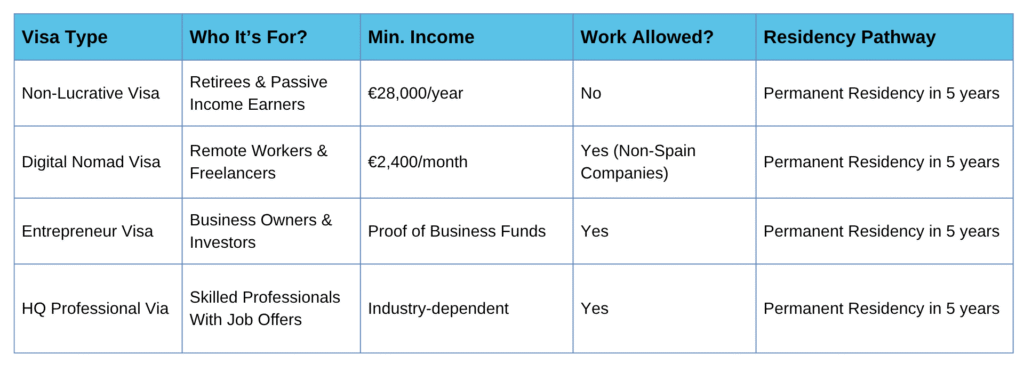
Summary: Spain Visa Options at a Glance
Want to compare all visas at a glance? See our summary table here.
Learn more about our global mobility services for UK expats.
Living in Spain
Why do British Expats Choose to Live in Spain?
For many UK nationals, Spain continues offering one of the strongest lifestyle propositions anywhere in Europe.
Climate, healthcare, lower living costs, Mediterranean culture and established UK expat communities continue attracting British retirees, remote workers and internationally mobile families despite post-Brexit residency changes.
While the legal process has become more structured after Brexit, long-term Spanish residency remains highly achievable for well-prepared UK applicants.
Lifestyle in Spain
Spain is renowned for its vibrant culture, delicious cuisine and relaxed work-life balance, making it an appealing destination for UK nationals seeking a better quality of life. The Mediterranean lifestyle is deeply ingrained in Spanish society, where social interactions, outdoor activities and family values play a crucial role.
Climate in Spain
One of the major attractions of living in Spain is its incredible climate. The climate in Spain varies by region, but generally, it offers hot summers, mild winters and plenty of sunshine throughout the year. The Mediterranean coastline, including Costa del Sol and Alicante, experiences warm temperatures, making it perfect for outdoor activities and relaxation. Whether it’s enjoying the beach lifestyle, hiking in the Sierra Nevada, or sipping wine at a seaside café, the weather in Spain allows for a more active and enjoyable lifestyle.
Safety in Spain
Safety in Spain is another key consideration for UK nationals moving abroad. Spain consistently ranks as one of the safest European countries, with low crime rates and a strong police presence. The country maintains high safety standards in both urban and rural areas, making it a secure place for families, retirees and professionals. Whether in major cities like Madrid and Barcelona or quieter coastal towns, residents benefit from well-maintained public spaces, effective law enforcement, and a general sense of security.
The lifestyle in Spain offers a perfect blend of relaxation, culture, and adventure, making it one of the most attractive destinations for British expats. From its favourable climate and high safety standards to its rich culinary traditions and thriving social scene, Spain provides an exceptional quality of life for those looking to relocate and settle in a vibrant, welcoming country.
Cost of Living in Spain for UK Expats
Spain can offer UK expats significantly lower living costs than many parts of the UK, particularly for housing, dining, transport and lifestyle spending.
However, costs vary substantially depending on region, property choices, schooling, healthcare preferences and tax exposure.
The strongest relocations are usually those where UK pensions, property, taxation and day-to-day living costs are modelled together before relocation rather than after becoming Spanish tax resident.
For detailed data, consult official statistics published by the Instituto Nacional de Estadística.
UK vs Spain Cost of Living Comparison
To give UK nationals a clear, like-for-like view, the table below compares everyday living costs in Spain and the UK using GBP figures. This helps assess how far UK income, pensions or savings can stretch when relocating to Spain.
| Category | Spain (GBP) | UK (GBP) | Notes |
|---|---|---|---|
| Rent – 1 bed city centre | £800 | £1,200 | Madrid/Barcelona vs London avg |
| Utilities (monthly) | £85 | £180 | Lower energy & service costs |
| Groceries (monthly) | £220 | £300 | Local produce cheaper |
| Public transport (monthly) | £50 | £200 | Metro & bus passes |
| Dining out (meal for 2) | £35 | £60 | Mid-range restaurant |
| Average net salary | £1,700 | £2,600 | Lower wages but lower costs |
Cost of Living in Spain vs UK
- Rent:
Madrid (€1,000/month) vs. London (£2,000/month): Save 50%! - Dining Out:
Spain (€12 meal) vs. UK (£18 meal): Save 30%! - Transport:
Madrid Metro (€55/month) vs. London (£200/month): Save 70%!

Groceries & Dining: 20-40% cheaper than in the UK. A meal at a mid-range restaurant costs around €12, compared to £18 in the UK.

Public Transport: Monthly metro pass: Madrid (€55) vs. London (£200+). A taxi ride in Spain is on average 30% cheaper than in the UK.

Utilities & Internet: Electricity bills range from €60-€100/month depending on location, compared to £150+ in the UK. Internet plans in Spain start from €30/month.
Spain’s overall cost of living allows expats to enjoy a comfortable lifestyle at a lower price.
Schooling in Spain
For families relocating, schooling in Spain is an important factor. Spain offers a range of educational options, including public, private, and international schools. International schools are popular among expats as they provide British, American, or IB curriculums, easing the transition for children.
Independent benchmarking is available in the OECD overview of Spain’s education system.
Community in Spain & Expat Life in Spain
Spain has a well-established expat community, particularly in regions like Costa Blanca, Costa del Sol and Barcelona. British expats in Spain benefit from a strong support network, including expat clubs, networking groups and social gatherings. This makes living in Spain easier and more enjoyable.
Healthcare in Spain
The healthcare in Spain system is among the best in the world, with both public and private services offering high-quality medical care. Expats moving to Spain from UK should consider securing health insurance in Spain to access private healthcare facilities, which provide shorter wait times and English-speaking medical professionals.
Health and life insurance are key considerations for UK nationals moving to Spain.
Medical Insurance Spain
Having medical insurance Spain is essential for expats who are not covered under Spain’s public healthcare system. Private health insurance Spain ensures access to top-tier healthcare services and is often a requirement for residency applications.
By understanding these key aspects of living in Spain, UK nationals can make informed decisions and enjoy a seamless transition into their new life abroad.
Best Places to Live in Spain
Spain has something for everyone, whether you prefer the energy of a big city, the relaxed pace of a coastal town or the charm of a countryside retreat. The best places to live in Spain vary depending on lifestyle preferences, climate and affordability. Below are some of the most popular destinations for expats looking to relocate.
Great Places to Live in Spain
From vibrant cities to tranquil coastal regions, Spain offers a diverse range of locations suited to different lifestyles. Whether you are looking for a bustling urban environment, a laid-back beachside town or a scenic rural retreat, Spain has plenty of great options for expats. Below are some of the best places to live in Spain for UK nationals looking to settle in the country.
Best Cities to Live in Spain
Spain’s cities offer a mix of vibrant culture, modern amenities, and rich history, making them attractive destinations for expats. Whether you’re looking for a fast-paced urban environment, a coastal city with stunning beaches, or a relaxed and affordable alternative, Spain has a city to suit every lifestyle.

Madrid
For those who thrive in a bustling metropolis, Madrid is often considered the best place to live in Spain. As the capital, it offers world-class amenities, international schools, cultural attractions and strong job opportunities. The city is home to a large expat community, making integration easy.

Barcelona
Barcelona is another great place to live in Spain, combining stunning architecture, Mediterranean beaches and a dynamic business environment. Expats who enjoy a balance of city life and coastal living will find Barcelona an ideal choice.

Valencia
Valencia is gaining popularity as one of the best regions to live in Spain due to its affordable housing, excellent healthcare and fantastic climate. With a slower pace of life than Madrid or Barcelona, it is perfect for families and retirees.
Best Regions to Live in Spain
Spain offers a variety of regions that appeal to expats, from sun-drenched coastal areas to charming countryside retreats. Whether you’re looking for a lively expat community, stunning natural scenery, or a quiet place to settle, these regions stand out as some of the best places to live in Spain.

Costa del Sol
The Costa del Sol is one of the best places to live in Spain for retirees and expats seeking year-round sunshine and a strong English-speaking community. Malaga, Marbella and Estepona are top choices for expats looking for Spanish property along the coast.

Alicante
Alicante is a great place to live in Spain for expats seeking an affordable cost of living, excellent transport links and vibrant nightlife. It is also a hotspot for those interested in buying a place in Spain at a reasonable price.

Mallorca
Mallorca offers a high quality of life and is regarded as one of the best places to live in Spain for those looking for an island paradise. The property in Spain market on the island includes everything from traditional fincas to modern villas.
Buying Property in Spain
Buying property in Spain is not simply a lifestyle decision — for many UK nationals it becomes a major part of residency planning, retirement strategy and long-term wealth structuring.
Spain offers one of Europe’s most diverse property markets, ranging from affordable inland homes to premium coastal and city-centre real estate.
Spanish property prices vary substantially by region, with Madrid and Barcelona remaining among the country’s most expensive markets due to international demand, employment concentration and limited supply.
Regions such as Costa del Sol, Alicante and Valencia continue attracting UK expats because they combine lower living costs, established UK expat infrastructure, strong transport links and comparatively more accessible property pricing.
Understanding the legal process of buying property in Spain is essential because taxes, succession rules, ownership structures and financing arrangements can materially affect long-term costs and tax exposure.
Most UK nationals benefit from professional legal, tax and residency guidance before committing to a Spanish property purchase.
However, UK nationals should never buy property in Spain without reviewing tax exposure, succession implications, financing structure and long-term residency objectives first.
The most expensive mistakes usually happen when buyers focus purely on lifestyle without modelling tax and ownership consequences properly.
Whether you are searching for Spanish property as an investment, considering buying a home in Spain for permanent residency or simply exploring the best places to live in Spain, careful research and professional advice can make your relocation smoother.
Before selling UK property or transferring pensions, align your decisions with a coordinated exit plan.
Tel: +44 208 058 8937 or Email: connect@adviceforexpats.com.
Taxes in Spain: Essential Guide for UK Expats
Understanding Taxes in Spain
Understanding Spanish taxation is one of the most important parts of relocating successfully. Spain can offer excellent lifestyle value, but tax exposure can become significantly more complex once UK nationals become Spanish tax resident.
Spanish tax residency generally creates worldwide income reporting obligations, potentially affecting UK pensions, offshore assets, investments, capital gains and inheritance tax planning.
The UK–Spain double taxation treaty helps reduce dual taxation, but it does not remove the need for proper cross-border tax planning before relocation.
Most expensive tax mistakes happen because UK nationals trigger Spanish tax residency before reviewing UK pensions, investments, reporting obligations and succession tax exposure properly.
UK vs Spain Tax Comparison
To help UK expats assess the real financial impact of relocating, the table below provides a side-by-side comparison of key UK and Spanish taxes. This highlights where Spain may offer advantages — and where additional tax planning is required, particularly around wealth tax, capital gains and inheritance tax exposure.
| Category | UK | Spain | Notes |
|---|---|---|---|
| Income Tax | 20%–45% progressive | 19%–47% progressive | Higher top rate in Spain |
| Capital Gains Tax | 10%–28% | 19%–28% | Similar bands |
| Dividend Tax | 8.75%–39.35% | 19%–28% | Spain lower at lower bands |
| Wealth Tax | None | 0.2%–3.5% (regional) | Spain levies wealth tax |
| Inheritance Tax | 0%–40% | 0%–34% (regional) | Spain varies by region |
| VAT | 20% | 21% | Slightly higher in Spain |
| Corporate Tax | 25% | 25% | Same headline rate |
Becoming a Spanish Tax Resident
A Spanish tax resident is someone who spends more than 183 days per year in Spain or has their centre of economic and vital interests in the country. The Spanish tax year runs from 1st January to 31st December and residents must file an annual tax declaration Spain covering all global income. High-net-worth individuals must also comply with Modelo 720 Spain, a declaration of overseas assets exceeding €50,000.
Spanish tax residency criteria are legally defined by the Spanish Tax Agency (Agencia Tributaria).
Income Tax in Spain
Income tax Spain applies to all Spanish tax residents on their global earnings. Tax bands Spain are progressive, starting at 19% and increasing to 47%, depending on income levels. Various deductions are available, including allowances for pensions and dependents. Many expats use a Spanish Tax Calculator to estimate their tax liability before filing.
For more details, use the Spanish tax calculator below:
Dividend Tax in Spain
For those receiving dividend income, dividend tax in Spain is an important consideration. Residents in Spain pay 19% to 26% tax on dividend earnings, depending on the total amount received. The UK-Spain double tax treaty helps prevent dual taxation, allowing UK expats to offset some taxes paid in the UK against their Spanish liabilities.
Capital Gains Tax in Spain
Selling a property or other assets in Spain or elsewhere may trigger capital gains tax Spain. The rates range from 19% to 28%, depending on the amount of profit made. Certain exemptions apply, such as reinvesting proceeds into another primary residence.
Succession Tax in Spain
Succession tax Spain applies to inheritances received in Spain, with rates varying by region. While close relatives may benefit from tax exemptions, non-resident heirs could face higher taxation. Estate planning is crucial for UK expats to mitigate unexpected liabilities.
Spanish Wealth Tax
For individuals with significant assets, Spanish wealth tax is levied on net worldwide wealth, starting from 0.2% to 3.5%, depending on the region. The tax applies to both tax residents and non-residents with wealth in excess of €3 million in regions where significant tax deductions or 100% exemptions apply.
Beckham Law Spain
The Beckham Law Spain is a tax regime designed to attract highly skilled foreign workers, including expats relocating for employment. Under the Beckham Law Spain, qualifying individuals can opt to be taxed as non-residents for up to six years, paying a flat 24% tax rate on Spanish earnings up to €600,000, rather than the progressive rates applied to residents. It is also worth noting that certain types of foreign income such as cgt Spain, dividend tax Spain and inheritance tax in Spain are exempt under this law.
Learn more about our tax planning for UK expats.
Planning to relocate within the next 12 months?
Structure your UK tax and pension position before committing to residency abroad.
Book My Free 15-Minute Exit Strategy Call.
Limited private strategy slots available each week.
Trusted by UK nationals globally.
Prefer to speak directly? Tel: +44 208 058 8937.
Email: connect@adviceforexpats.com.
Financial Considerations of Retirement in Spain
Comprehensive Financial Management
Retirement in Spain can offer UK nationals an exceptional combination of lifestyle, climate, healthcare and long-term quality of life — but only when the financial structure is correct before relocation.
For many British retirees, the biggest risks involve pensions, tax residency, inheritance exposure, currency management and poorly timed UK exits rather than lifestyle decisions themselves.
Successful retirement planning in Spain normally requires coordinated management of pensions, investments, taxation, estate planning and long-term income sustainability before Spanish tax residency begins.
Expat Wealth Management
Effective wealth management in Spain is not simply about investment performance — it is about protecting pensions, investments, family wealth and long-term financial flexibility across multiple jurisdictions.
For UK expats, the strongest strategies normally combine tax-efficient investment planning, remittance management, succession planning and long-term wealth preservation.
Spanish tax residency can materially affect offshore assets, pensions, investment structures and inheritance exposure, making coordinated financial planning increasingly important after relocation.
The most successful UK expats usually review wealth structures before relocation rather than attempting to restructure after becoming Spanish tax resident.
Pensions in Spain
Understanding how UK pensions interact with Spanish tax residency is one of the most important parts of retirement planning for British expats.
Recent UK tax changes and evolving Spanish treatment of overseas pensions have materially reduced the attractiveness of many traditional QROPS structures for UK nationals moving to Spain.
For many UK expats, International SIPPs and carefully structured pension drawdown strategies now offer greater flexibility, tax efficiency and long-term planning control.
Poorly timed pension access can create unnecessary Spanish tax exposure, making pre-relocation pension planning increasingly important for UK nationals.
Financial Planning for UK Expats
Financial planning for UK expats moving to Spain should begin before relocation rather than after becoming Spanish tax resident.
The strongest strategies usually coordinate pensions, investments, tax residency, inheritance tax planning and long-term income sustainability together.
Without financial planning, UK nationals can unintentionally create unnecessary tax exposure, reporting obligations and long-term financial inefficiencies after relocation.
Most financially successful relocations involve reviewing asset structures, remittance planning and retirement income before Spanish residency begins.
Spanish Compliant Bonds
Spanish compliant investment bonds remain one of the most widely used wealth-planning tools for UK expats living in Spain.
These structures can offer tax deferral advantages, investment flexibility and more efficient long-term reporting treatment under Spanish tax rules.
For many British expats, Spansish compliant bonds also help simplify administration and long-term cross-border investment management after becoming Spanish tax resident.
However, suitability depends heavily on residency status, investment objectives, income needs and overall estate-planning strategy.
Finding the Best Forex Brokers in Spain
Currency exchange planning is one of the most underestimated financial risks for UK nationals moving to Spain.
Large GBP-to-EUR transfers involving property purchases, pensions, investments or living expenses can become materially more expensive if exchange-rate volatility is ignored.
Many UK expats use specialist foreign-exchange providers because they often offer stronger exchange rates, lower fees and better long-term transfer management than traditional banks.
Look for providers that offer transparent pricing, minimal service fees and fast transactions. Many FX services in Spain now offer online conversion FX tools, allowing you to check live exchange rates before making a transaction.
Learn more about our currency exchange for UK expats.
Why Use a Forex Broker?
For those making significant financial transfers—such as purchasing property, moving pensions or sending money internationally — working with a forex broker can be highly beneficial. They offer:
- Better exchange rates than banks.
- Lower transfer fees.
- Hedging strategies to protect against currency fluctuations.
- Fast and secure transactions.
Get the Best Rates Today!
If you need money exchange services in Spain, don’t settle for high bank fees. Explore trusted forex brokers and currency exchange specialists to get the most competitive rates. Start saving now by finding the best money exchange services near you!
Why Choose Advice for Expats?
At Advice for Expats, we help UK nationals structure the financial and practical side of relocation before the move becomes expensive or difficult to unwind.
Moving to Spain is not simply a visa process — it is a residency, tax, pension, healthcare and wealth-planning project that requires proper coordination from the outset.
The most expensive mistakes usually happen before relocation: triggering Spanish tax residency too early, choosing the wrong residency route, accessing UK pensions incorrectly or failing to structure assets properly before departure from the UK.
Our role is to help UK nationals avoid those mistakes while building a compliant, tax-efficient and financially secure long-term structure in Spain.
Our team combines practical relocation expertise with deep understanding of UK exit planning and Spanish residency, tax and reporting rules to help UK nationals relocate with greater clarity and fewer costly mistakes.
At Advice for Expats, we provide:
- Expert financial planning tailored specifically for UK nationals relocating to Spain.
- Comprehensive relocation support throughout the Spanish residency process, including visa applications, permit strategy and compliance planning.
- End-to-end relocation planning covering tax strategy, pensions, healthcare, property, insurance and long-term wealth management.
- Coordinated cross-border planning built around UK exit rules and Spanish residency, tax and reporting requirements.
- Access to a trusted professional network in Spain to support high-quality relocation execution across legal, tax, property and financial matters.
Start your move to Spain with greater confidence, clarity and financial control.
We provide gold-plated, end-to-end relocation and financial-planning support for UK expats moving to Spain.
Frequently Asked Questions (FAQ) on Moving to Spain from UK
UK nationals can move to Spain without a Golden Visa by applying for a long-stay route such as the Non-Lucrative Visa (no work), the Digital Nomad Visa (remote work) or a work/entrepreneur route. You must apply via a Spanish consulate, then register locally after arrival.
Speak to a residency expert for details! Call us on Tel: +44 208 058 8937 or Email: connect@adviceforexpats.com
Yes. UK citizens can live in Spain long-term by maintaining legal residency under a qualifying visa route. After five years of continuous legal residence, you may qualify for long-term/permanent residence, subject to meeting renewal and compliance requirements.
No. The Schengen 90/180-day rule still applies to UK nationals visiting Spain without residency. To stay beyond 90 days in any 180-day period, you must obtain a long-stay visa and residence permit.
If you become Spanish tax resident (typically 183+ days or centre of vital interests), Spain taxes worldwide income and may require foreign asset reporting (e.g., Modelo 720). UK tax may still apply to UK-sourced income depending on residency and treaty rules.
Spain is generally cheaper than the UK for rent, groceries, transport and dining, although costs vary by region. Madrid and Barcelona are pricier than smaller cities, while many coastal and inland areas offer significantly lower living costs than most UK regions.
UK nationals need a long-stay visa such as the Non-Lucrative Visa, Digital Nomad Visa, Entrepreneur Visa or Highly Qualified Professional Visa. The best choice depends on whether you will work, work remotely, or live on passive income.
Yes, for many long-stay visas Spain requires private medical insurance with full coverage in Spain and no co-payments. Even after arrival, many expats keep private cover for faster specialist access, especially during the early residency phase.
You are generally Spanish tax resident if you spend more than 183 days in Spain in a calendar year or Spain becomes your main centre of economic/vital interests. Tax residency triggers worldwide income reporting and can affect pensions, dividends and gains.
Modelo 720 is a declaration of overseas assets for Spanish tax residents when certain foreign asset thresholds are exceeded (commonly €50,000 categories). It applies to bank accounts, investments and certain property held outside Spain, and it’s a key compliance risk for new arrivals.
The Beckham Law allows qualifying foreign workers to be taxed as non-residents for up to six years, often at a flat rate on Spanish employment income (subject to rules and thresholds). It has strict deadlines and eligibility requirements, so timing is critical.
Yes. UK pensions can be paid while you live in Spain. If you are Spanish tax resident, pension income is generally taxable in Spain, and the UK–Spain treaty helps prevent double taxation. Planning before becoming resident improves outcomes.
UK nationals can buy property in Spain, but property ownership does not automatically grant residency. You must still qualify under a visa route. Buyers should budget for purchase taxes, legal costs and ongoing regional taxes, including possible wealth/succession exposure.
Still have questions about moving to Spain from UK?
Get expert answers from our team today!
Tel: +44 208 058 8937 or Email: connect@adviceforexpats.com.
People Also Ask
Popular choices include Costa del Sol, Costa Blanca (Alicante), Valencia, Madrid and Barcelona, depending on budget and lifestyle. Many UK expats prioritise healthcare access, transport links and established English-speaking communities.
It depends on visa route and location. For a Non-Lucrative Visa you must show sufficient financial means and private health insurance. Retirement budgets vary widely, but many retirees find Spain cheaper than the UK outside Madrid/Barcelona.
Yes. Many UK retirees use pension income to qualify for the Non-Lucrative Visa. Once resident, the pension may be taxable in Spain, so pre-move structuring and treaty planning is important.
It depends on whether you remain UK tax resident under the UK Statutory Residence Test. Even if non-resident, UK-sourced income may still be taxable in the UK. Spain may tax worldwide income if you become Spanish tax resident.
Yes, but UK nationals must apply for a long-stay visa and residence permit for stays beyond 90 days. Spain remains accessible, but the process is now visa-based and document-driven.
UK citizens can stay up to 90 days in any 180-day period under Schengen short-stay rules. Longer stays require a residence visa and permit.
Yes. Spain is popular for climate, lifestyle, strong expat networks and good healthcare. The main issues are visa admin, tax residency planning and regional differences in cost and taxes.
Yes. Private health insurance is required for many long-stay visas and is commonly used by new arrivals. Once resident, eligibility for public healthcare depends on status and registration, but private cover remains common for speed and access.
Secure Your Financial Future in Spain
Moving to Spain from UK is not simply about visas and property — it is about protecting your tax position, pensions, investments and long-term financial security before relocation begins.
At Advice for Expats, we help UK nationals relocate to Spain with clarity, compliance and long-term financial confidence by aligning residency planning, taxation, pensions and wealth protection before Spanish tax residency begins.
The most successful relocations are never rushed. They are structured strategically before the first major financial decision is made.
Our services cover:
• Relocation planning covering Spanish visas, residency applications, registration requirements and long-term compliance.
• Tax planning, retirement planning and estate structuring designed specifically for UK nationals becoming resident in Spain.
• Property, insurance and mortgage guidance aligned with Spanish residency, tax exposure and long-term financial objectives.
• Cross-border financial planning and wealth-management advice built around the needs of UK expats living in Spain.
Don’t leave your relocation exposed to avoidable tax, pension and residency mistakes. We help UK nationals manage the complexity before problems become expensive and difficult to reverse later.
Once you relocate to Spain, reversing financial mistakes becomes far more expensive.
Protect your wealth, pensions and tax position before you go.
Tel: +44 208 058 8937 or Email: connect@adviceforexpats.com.