





Moving to Portugal from UK
One Client. One Journey. One Platform.
- 1 Article Summary: Moving to Portugal from UK
- 2 Key Takeaways for UK Nationals Moving to Portugal
- 3 Pros & Cons of Moving to Portugal from UK
- 4 Biggest Mistakes UK Expats Make When Moving to Portugal
- 5 Who Is This For / Not For: Moving to Portugal from UK
- 6 Solutions for High-Net-Worth UK Nationals Moving to Portugal
- 7 What Changed in 2025 for UK Nationals Moving to Portugal
- 8 Hot Off the Press: Latest Updates for UK Nationals Moving to Portugal
- 9 Moving to Portugal from UK: The Complete Guide for UK Expats
- 10 How Easy is it to Move to Portugal from UK?
- 11 Challenges of Moving to Portugal for UK Expats
- 12 How to Move to Portugal from UK: Step-by-Step Guide
- 13 Visa & Residency Options for UK Nationals Moving to Portugal
- 14 Portugal Visa Options at a Glance
- 15 Living in Portugal: Lifestyle, Culture & Community
- 16 Is Portugal a Good Place to Live?
- 17 Cost of Living in Portugal for UK Expats
- 18 Community & Expat Life in Portugal
- 19 Schools in Portugal for UK Families
- 20 Healthcare in Portugal for UK Expats
- 21 Best Places to Live in Portugal for UK Expats
- 22 Best Cities to Live in Portugal
- 23 Where is the Best Place to Live in Portugal as a UK Expat?
- 24 Best Towns in Portugal for UK Expats
- 25 Buying Property in Portugal for UK Expats
- 26 Renting in Portugal for UK Expats
- 27 Getting a Mortgage in Portugal for UK Expats
- 28 Taxes in Portugal: Essential Guide for UK Expats
- 29 Becoming a Portuguese Tax Resident
- 30 UK-Portugal Double Tax Treaty
- 31 Income Tax in Portugal
- 32 Capital Gains Tax in Portugal
- 33 Inheritance Tax in Portugal
- 34 Portuguese Wealth Tax
- 35 Tax Exemptions & Incentives in Portugal
- 36 How IFICI+ Compares to NHR
- 37 How to get a Portugal Passport?
- 38 How to get Portugal Citizenship?
- 39 Portugal Permanent Residence
- 40 Financial Considerations of Living in Portugal
- 41 Wealth Management for UK Expats in Portugal
- 42 How Expats Can Maximize Their Finances in Portugal
- 43 Portuguese Compliant Bonds
- 44 Currency Exchange & Forex Advice for UK Expats in Portugal
- 45 Why Choose Advice for Expats?
- 46 FAQs: Moving to Portugal from UK
- 47 People Also Ask: Moving to Portugal from UK
- 48 Secure Your Financial Future Today
Article Summary: Moving to Portugal from UK
Moving to Portugal from UK remains one of the most attractive relocation options for British nationals seeking lifestyle, affordability, EU residency access and long-term financial security. However, Portugal is no longer a simple low-tax relocation choice. Post-Brexit rules, visa requirements, Portuguese tax residency, healthcare access, pension planning and the revised NHR/IFICI+ landscape all need to be structured before relocation.
This guide explains how UK expats can relocate to Portugal confidently, choose the correct visa route, avoid costly tax and residency mistakes and build a secure, compliant life abroad with proper financial planning from the outset.
Key Takeaways for UK Nationals Moving to Portugal
- UK nationals require a long-stay visa or residence permit to live in Portugal after Brexit.
- You need to qualify under the correct visa route, such as the D7, D8, D2, Golden Visa or HQA route, depending on income, work, investment or business structure.
- Residency approval depends on proof of income, suitable accommodation, compliant healthcare cover and complete supporting documentation.
- Portuguese tax residency generally applies after 183 days, or where Portugal becomes your habitual residence.
- The benefits include strong UK expat infrastructure, warm climate, lifestyle appeal, healthcare access and a clear route to long-term EU residency.
- To qualify, UK nationals usually need to apply through the Portuguese consular process before relocating and then complete local registration after arrival.
- The steps are choose the correct visa, apply, relocate, register locally, obtain tax status and manage ongoing residency compliance.
- Portugal remains accessible for UK nationals, but the strongest outcomes come from structured pre-relocation planning around visas, tax, pensions and income.
- The biggest opportunity is securing Portuguese residency while aligning pensions, investments and tax planning before becoming fiscally resident.
- The biggest risk is relocating first and only later discovering that your visa route, tax position, pension income or investment structure has been handled in the wrong order.
Pros & Cons of Moving to Portugal from UK
Pros
- Portugal offers UK nationals a high quality of life supported by warm weather, coastal living, strong healthcare access and established UK expat communities.
- UK nationals benefit from established residency pathways for non-EU citizens, including D7, D8, D2, Golden Visa and HQA options
- The lifestyle combines Mediterranean climate, Atlantic coastline, lower living costs and well-established British expat networks.
Cons
- Visa applications require careful preparation, complete documentation and correct sequencing before relocation.
- Administrative delays, appointment backlogs and regional processing differences can affect relocation timelines.
- Structured tax planning is essential before becoming Portuguese tax resident, particularly for UK pensions, investments, property income and capital gains.
Biggest Mistakes UK Expats Make When Moving to Portugal
- Assuming Portugal is still “easy” post-Brexit and underestimating the documentation, timing and sequencing required for residency approval.
- Triggering Portuguese tax residency without understanding how worldwide income, UK pensions, investment gains and property income may be taxed.
- Relying on outdated assumptions about the old Portugal NHR regime without planning around the revised IFICI+ and transitional eligibility rules.
- Choosing the wrong visa route — D7, D8, D2, Golden Visa or HQA — for your income type, work pattern, investment plans or long-term residency goals.
- Assuming public healthcare access is immediate without arranging compliant private health insurance during the initial residency phase.
- Failing to align UK exit planning with Portuguese tax residency, creating avoidable tax exposure around HMRC, UK pensions, investment gains and overseas income.
Who Is This For / Not For: Moving to Portugal from UK
Who This Is For
- UK nationals seeking long-term residency in Portugal with proper visa, tax and financial planning.
- This is for UK retirees, families, remote workers, entrepreneurs and investors who want a structured route into Portugal.
- The requirement is stable income, suitable documentation, healthcare cover and readiness to manage Portuguese residency and tax compliance.
Who This Is Not For
- This is not suitable for people expecting instant relocation without paperwork, consular processing or residency documentation.
- This is not for individuals unwilling to follow Portuguese visa rules, tax registration requirements or local compliance obligations.
- Portugal is not suitable for UK nationals who want to relocate without planning tax residency, UK pensions, investments and UK departure steps properly.
Solutions for High-Net-Worth UK Nationals Moving to Portugal
- High-net-worth UK nationals require pre-arrival planning to manage Portuguese tax exposure before becoming tax resident.
- Strategic relocation planning should cover UK pension transfers, investment portfolios, capital gains timing, property income, business interests and inheritance exposure.
- Portuguese tax residency timing should be aligned carefully with UK Statutory Residence Test planning and wider global tax considerations.
- This is especially important for UK nationals with cross-border assets, business interests, trusts, investment portfolios or multi-jurisdiction income.
- Portuguese tax residency can change the treatment of worldwide income, making timing and structure critical before relocation.
- The potential benefits include wealth protection, estate planning, tax efficiency and long-term financial security — but only when the move is structured before residency begins.
What Changed in 2025 for UK Nationals Moving to Portugal
- Portugal formally closed the traditional NHR regime to most new applicants, replacing it with more targeted incentive routes focused on recognised economic, professional, scientific and innovation-led activities.
- The IFICI+ regime was clarified and expanded in February 2025, defining qualifying sectors and routes for professionals, entrepreneurs, investors and selected high-value activities.
- Portugal increased scrutiny of tax residency declarations, particularly around foreign pension income, investment structures and income sources held by UK nationals.
- Property and residency applications are facing tighter source-of-funds, compliance and documentation checks, extending processing timelines for some applicants.
Hot Off the Press: Latest Updates for UK Nationals Moving to Portugal
- Demand from UK nationals remains strong despite NHR changes, with more interest shifting toward D7, D8, HQA and investment-led residency routes.
- Portuguese authorities are applying tax residency rules more consistently across regions, reducing flexibility for informal or poorly documented arrangements.
- Private healthcare capacity continues expanding, reinforcing the importance of insurance-led access for new tax residents during the initial relocation phase.
- Portugal’s residency-to-citizenship pathway remains one of Europe’s most stable, provided UK nationals maintain clean residency, tax compliance and documentation throughout the qualifying period.
- UK pension, investment and capital gains planning is becoming more important as Portugal’s post-NHR landscape becomes more targeted and less forgiving of poor pre-arrival structuring.
Moving to Portugal from UK: The Complete Guide for UK Expats
Moving to Portugal from UK is no longer just a lifestyle decision. UK nationals must now plan visas, tax residency, UK pensions, healthcare, property decisions and UK exit steps before relocating. This guide helps British expats understand the practical, financial and legal issues that must be structured correctly before the move.
Why Move to Portugal? Benefits for UK Expats
Portugal remains highly attractive for UK nationals seeking lifestyle, affordability, residency access and long-term financial security. However, the benefits are strongest when the move is structured properly around visa choice, tax residency, pensions, healthcare and income planning before relocation.
Whether you are moving to Portugal for retirement, remote work, investment or family lifestyle, the decision should be treated as a financial and residency planning exercise — not simply a lifestyle move.
Some UK nationals consider moving to Spain from UK, particularly for those seeking EU residency, proximity to the UK and a Mediterranean lifestyle.
Others consider moving to Australia from UK, particularly for long-term residency, career opportunities and lifestyle change.
Experience Portugal: See Why Expats Love Living Here!
Thinking of moving to Portugal from UK? Watch this video to see why thousands of UK expats choose Portugal for its warm climate, tax advantages and incredible lifestyle!
Moving abroad without a properly structured UK exit plan can trigger unexpected tax liabilities, UK pension complications and costly residency mistakes.
- Avoid UK tax residency mistakes before departure.
- Protect your pensions before accessing or transferring benefits.
- Structure tax residency correctly from day one.
- Secure cross-border tax compliance and protect your global assets.
Book My Free 15-Minute Exit Strategy Call.
Limited private strategy slots available each week.
Trusted by UK nationals globally.
Prefer to speak directly? Tel: +44 208 058 8937.
Email: connect@adviceforexpats.com.
Why British Expats are Moving to Portugal from UK: Key Benefits
Portugal appeals to UK nationals because it combines lifestyle quality, lower living costs, established residency routes and long-term EU access. However, the relocation must now be planned more carefully because post-Brexit visa rules, tax residency and the revised NHR/IFICI+ framework have changed the planning landscape.
Others weighing European options may also explore moving to France from UK, particularly for career opportunities, established infrastructure and access to mainland Europe.
Can UK citizens move to Portugal after Brexit? Yes however the route must be selected correctly. Portugal remains a leading choice for British expats when visa eligibility, tax planning and long-term financial structuring are aligned from the outset.
- Favourable Climate: Enjoy over 300 days of sunshine per year, offering a relaxed and outdoor-friendly lifestyle.
- Affordable Cost of Living: Compared to the UK, Portugal provides a lower cost of living, particularly in housing, groceries, and healthcare.
- Tax Planning Opportunities: Portugal can still offer attractive tax planning opportunities for qualifying tax residents, but the old NHR assumptions no longer apply automatically.
- Residency Options: UK nationals have several pathways to residency in Portugal, including the D7 Visa (Passive Income Visa), D8 Visa (Digital Nomad Visa), and Golden Visa (Investment Visa).
- Strong Expat Community: A thriving British expat community helps newcomers integrate more easily.
- Excellent Healthcare System: Portugal offers both high-quality public healthcare through SNS and accessible private healthcare options.
- Safety & Quality of Life: Portugal is ranked among the safest countries in the world, making it an ideal place to live.
- Easy Travel to the UK: Frequent flights and strong transport links ensure convenient access between Portugal and the UK.
How Easy is it to Move to Portugal from UK?
Moving to Portugal from UK is achievable, but it is no longer informal or automatic after Brexit. UK nationals must choose the correct visa route, prepare compliant documentation, secure accommodation, arrange healthcare cover and understand when Portuguese tax residency begins.
The biggest mistake is treating the process as a simple lifestyle move. The correct sequence matters because visa approval, tax residency, pensions, healthcare and property decisions can all affect the final outcome.
- Step 1: Obtain a Portuguese Tax Identification Number (NIF).
- Step 2: Open a Portuguese bank account.
- Step 3: Choose a visa for Portugal from UK and apply accordingly.
- Step 4: Secure proof of residence, such as a rental or property purchase agreement.
- Step 5: Register with local authorities upon arrival.
Official requirements are outlined in UK government living in Portugal guidance for British nationals.
Challenges of Moving to Portugal for UK Expats
While Portugal offers major lifestyle and residency advantages, UK nationals should understand the practical and financial risks before committing. Most problems arise from poor sequencing, weak documentation or assuming Portugal is still as simple as it was before Brexit.
Bureaucracy & Paperwork: Portuguese administration can be slow, particularly around visa applications, tax registration, residency appointments and property purchases. Weak documentation can delay the entire relocation.
Language Barrier: While English is commonly spoken in tourist areas and among expats, dealing with government offices and local businesses may require Portuguese proficiency.
Job Market & Salaries: Portugal has a lower average salary compared to the UK, making it less attractive for professionals seeking high-paying jobs.
Cost of Living in Key Areas: Portugal remains good value in many regions, but Lisbon, Porto and the Algarve have become more expensive. UK nationals should budget carefully before assuming Portugal is automatically low-cost.
Public Healthcare Wait Times: Expats on the D7 and Golden Visa can access the SNS healthcare system, but waiting times for specialists can be long.
Moving to Portugal from UK can be highly rewarding, but success depends on financial planning before you relocate. The right visa, tax position, pension strategy, healthcare cover and financial structure can make the difference between a smooth move and costly mistakes that are difficult to reverse.
How to Move to Portugal from UK: Step-by-Step Guide
- Plan Your Move: Review your preferred location, visa route, income position, tax exposure, pensions, healthcare and accommodation before committing.
- Visa Application: Apply under the correct Portugal visa route, such as D7, D8, D2, Golden Visa or HQA, based on your income, work, investment or business profile.
- Secure Accommodation: Arrange suitable accommodation that supports your visa and residency application.
- Healthcare & Banking: Arrange compliant health insurance, open banking arrangements and prepare for local registration. Residency Registration: Complete local registration and ensure your tax residency position is managed correctly from arrival.
Visa & Residency Options for UK Nationals Moving to Portugal
Portugal offers several residency routes for UK nationals, but there is no single “best” visa for everyone. The right option depends on income type, work status, investment plans, family needs, tax position and long-term citizenship goals. Choosing the wrong route can delay residency, increase tax exposure or create avoidable complications later.
Visa criteria are confirmed through the Portugal official visa portal.
Residency registration is overseen by the Portuguese immigration authority.
D2 Visa Portugal (For Business Owners and Entrepreneurs)
The D2 Visa Portugal is designed for entrepreneurs, business owners, and investors looking to establish or expand a business in Portugal. Applicants must provide a detailed business plan, demonstrate financial sustainability, and contribute to the Portuguese economy.
Key Requirements:
Investment in a Portuguese business or startup.
Visa Validity:
Initially valid for 2 years, extendable for 3 more years, leading to Portugal permanent residence.
D3 Visa Portugal (For Highly Skilled Workers)
The D3 Visa Portugal is designed for highly qualified professionals, researchers and specialists seeking employment in Portugal’s high-demand sectors. It provides a fast-track route to residency and potential EU Blue Card eligibility, making it an excellent option for individuals with advanced qualifications and specialized expertise.
The D3 Visa may align with Portugal’s revised tax incentive framework where the applicant qualifies under current rules. However, UK nationals should not rely on outdated NHR assumptions. Eligibility, sector qualification and tax treatment must be reviewed before relocation.
Key Requirements:
- Job Offer: A valid employment contract from a Portuguese employer for a highly skilled role.
- Professional Qualifications: A higher education degree or equivalent specialized experience in a relevant field.
- Salary Requirement: Must earn at least 1.5 times the national gross annual salary in Portugal.
- Proof of Accommodation: Evidence of a residential address in Portugal.
- Health Insurance: Private health coverage if not provided by the employer.
Visa Validity:
Initially valid for two years, extendable for an additional three years, leading to permanent residency in Portugal. After five years, applicants can apply for Portuguese citizenship.
D7 Visa Portugal (For Retirees & Passive Income Earners)
The D7 Visa Portugal is ideal for retirees and individuals with stable passive income such as pensions, rental income, or investments.
Key Requirements:
Minimum monthly income of €760 per person.
Visa Validity:
Initially granted for 2 years, renewable for 3 years, allowing a path to Portugal permanent residence.
D8 Visa Portugal (For Remote Workers & Digital Nomads)
The D8 Visa Portugal is tailored for remote workers, freelancers and digital entrepreneurs earning income from abroad.
Key Requirements:
Minimum monthly income of €3,040 from non-Portuguese sources.
Visa Validity:
1-year visa, renewable for up to 5 years, with eligibility for Portugal permanent residence.
Golden Visa Portugal (For High-Net-Worth Investors)
The Golden Visa Portugal is an investment-based residency program that provides a pathway to Portuguese citizenship.
Key Requirements:
Minimum investment of €500,000 in a Portuguese investment fund or approved projects.
Visa Validity:
Renewable residency leading to a Portugal passport after 5 years.
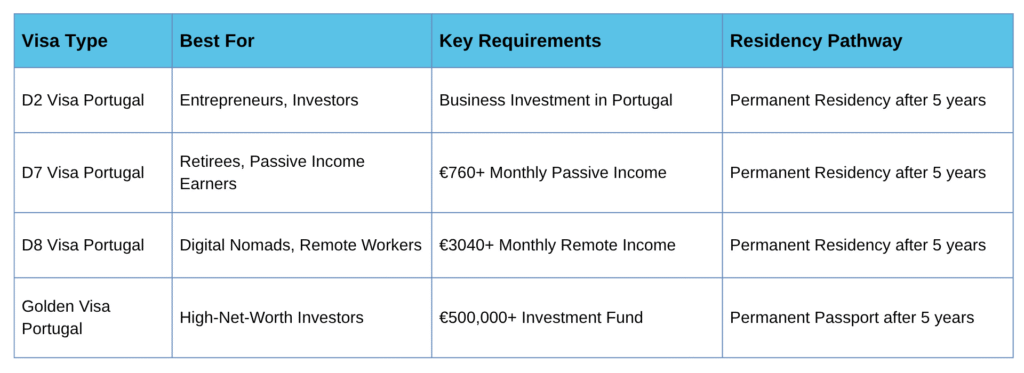
Portugal Visa Options at a Glance
Want to compare all visas at a glance? See our summary table here.
Portugal HQA® Visa Program (for Investors and Executives)
The Portugal HQA Visa program can be attractive for entrepreneurs, investors, executives and SMEs seeking a structured route to Portuguese residency through qualifying innovation, research or commercialisation projects. It may suit internationally mobile UK nationals who want residency access without relying on traditional passive-income routes.
Key Requirements:
- Investment starting at EUR 175,000 in qualifying innovative R&D or business projects.
- Choose between active engagement through incubation programs or passive investment options.
- Suitable for entrepreneurs, investors, executives and SMEs.
Visa Validity:
Residency under the HQA Visa is initially valid for two years, renewable for an additional three years. After five years, visa holders are eligible to apply for permanent residency or Portuguese citizenship.
Moving to Portugal from UK is an exciting opportunity for those seeking a better quality of life, financial advantages and a welcoming culture. While challenges exist, careful tax and financial planning and the right visa choice make the process smoother. With the right approach, your dream of living in Portugal can become a reality! Whether you are seeking retirement in the sun, a digital nomad lifestyle or an investment opportunity, Portugal offers diverse options to suit your needs. Start planning your move today and take advantage of expert guidance to make your transition seamless.
Living in Portugal: Lifestyle, Culture & Community
Living in Portugal can offer UK nationals a strong lifestyle upgrade, with warm weather, coastal towns, established UK expat communities and a slower pace of life. However, lifestyle should be assessed alongside tax residency, healthcare access, property costs, visa obligations and long-term financial planning.
Why do British Nationals Choose to Live in Portugal as an expat?
Portugal has long been a favourite destination for British expats. The country offers a high quality of life, excellent healthcare and a relatively affordable cost of living compared to the UK. Many UK expats appreciate the relaxed pace of life, friendly locals and well-established British communities in popular towns and cities. Living in Portugal as an expat provides a unique blend of tradition and modern living.
Is Portugal a Good Place to Live?
Portugal is widely regarded as an excellent place to live, whether for families, retirees or remote workers. With its stunning coastal towns, lively cities and rich cultural heritage, the country provides a unique and balanced lifestyle. Is Portugal a good place to live? Absolutely, thanks to its affordability, safety and high standard of living.
Climate in Portugal
Portugal enjoys a Mediterranean climate, with hot, dry summers and mild winters. The Algarve boasts over 3,000 hours of sunshine per year, making it one of the sunniest regions in Europe. Coastal cities like Lisbon and Porto enjoy moderate temperatures, while inland areas can be hotter in summer and cooler in winter. Portugal coastal cities such as Faro and Lagos are highly desirable for their mild climate and stunning ocean views.
Safety in Portugal
Portugal is considered one of the safest countries in the world. According to Portugal crime statistics, the country ranks among the lowest in Europe for violent crime. Expats often highlight the sense of security they feel, whether walking through cities at night or living in rural communities.
Cost of Living in Portugal for UK Expats
One of the major attractions for UK nationals moving to Portugal from UK is the potential for lower day-to-day living costs. However, affordability varies significantly by region. Lisbon, Porto and parts of the Algarve can be materially more expensive than smaller towns or inland areas, so UK expats should budget carefully before relocating.
For independent EU data comparing living costs across member states, review Eurostat price level data.
UK vs Portugal Cost of Living Comparison
To give UK nationals a clear, practical view of affordability, the table below compares everyday living costs in Portugal and the UK using GBP values, showing how far UK income or pensions typically stretch after relocation.
Cost of Living in Portugal vs UK
| Expense Category | Portugal (GBP) | UK (GBP) | Notes |
|---|---|---|---|
| Rent – 1 bed city centre | £700 | £1,200 | Lisbon/Porto vs London |
| Utilities (monthly) | £120 | £180 | Lower energy costs |
| Groceries (monthly) | £220 | £300 | Local produce cheaper |
| Public Transport (monthly) | £45 | £90 | Subsidised fares |
| Dining Out (meal for 2) | £35 | £60 | Lower restaurant prices |
| Private Healthcare (monthly) | £60 | £150 | Insurance cheaper |
Cost of Living in Portugal vs UK
The cost of living in Portugal is significantly lower than in the UK, making it an attractive option for expats seeking affordability without sacrificing quality of life.
Housing: Rental prices in Portugal are significantly lower than in major UK cities. A one-bedroom apartment in Lisbon or Porto costs around 30-50% less than a similar property in London.
Utilities: Electricity, water and internet bills are also more affordable.
Food & Dining: Eating out is much cheaper, with a meal at a local restaurant costing around €10-€15.
Healthcare: Private healthcare and health insurance in Portugal are relatively affordable, especially compared to UK private medical care.
Compare cost of living data via the OECD Portugal country snapshot.
Community & Expat Life in Portugal
British expats in Portugal form a well-established and active community. Many towns and cities, such as the Algarve, Lisbon, and Porto, have British-run businesses, clubs, and social groups. Expat life in Portugal is enriched by local festivals, cultural events, and a strong sense of community.
Schools in Portugal for UK Families
For families moving from the UK, schools in Portugal offer various options, including public, private and international schools.
- Public Schools: Free for residents but primarily taught in Portuguese.
- Private Schools: Offer high academic standards with bilingual programs.
- International Schools in Portugal: Follow British, American or IB curriculums, making it easier for expat children to adapt.
Healthcare in Portugal for UK Expats
Portugal has an excellent healthcare system, ranked among the best in Europe. UK expats can access both public and private healthcare services.
Public healthcare access is provided through the Portuguese public healthcare system for legal fiscal residents.
Health Insurance Portugal
While public healthcare is available to residents, many expats choose health insurance in Portugal for quicker access to private medical facilities. Private health insurance costs are significantly lower than in the UK and offer comprehensive coverage.
Living in Portugal as an expat offers an enviable lifestyle with great weather, a strong community and lower living costs. Whether you are drawn by the best cities in Portugal, its excellent schools, or world-class healthcare, Portugal remains one of the most attractive destinations for UK nationals. If you are considering making the move, now is the time to explore your options and secure your future in Portugal.
Best Places to Live in Portugal for UK Expats
Where do British expats live in Portugal? From sunny coastal retreats to buzzing city hubs, find the best place to suit your lifestyle and budget. Portugal offers a range of vibrant cities, scenic coastal towns and tranquil countryside retreats, each catering to different lifestyles. Whether you seek bustling urban life, a relaxed coastal atmosphere or an affordable yet charming town, Portugal has an ideal location for you.
Best Cities to Live in Portugal
Portugal offers a diverse range of cities, each with its own unique charm and appeal. Whether you prefer the bustling energy of a capital city, the historic attraction of an ancient town or the relaxed coastal lifestyle, Portugal has something to suit everyone. Below are some of the best cities in Portugal for expats looking to relocate.

Lisbon
Lisbon, the capital city, is a hub of culture, history, and business opportunities. Known for its stunning architecture, rich culinary scene, and vibrant nightlife, Lisbon is a popular choice for professionals and entrepreneurs. The city has an efficient public transport system, a thriving expat community, and excellent job prospects, making it one of the best cities in Portugal for professionals.

Porto
Located in northern Portugal, Porto is famous for its picturesque riverfront, historic centre, and world-renowned Port wine. Compared to Lisbon, Porto offers a lower cost of living while maintaining a high quality of life. With a growing tech industry and excellent healthcare facilities, it is an attractive option for expats looking for a balance between affordability and urban amenities.

Cascais
Cascais is a stunning coastal city known for its luxury lifestyle, beautiful beaches, and international community. With a relaxed yet sophisticated atmosphere, it is a desirable location for those considering Portugal retirement. Just a short drive from Lisbon, Cascais provides easy access to the capital while offering a more tranquil setting.
Where is the Best Place to Live in Portugal as a UK Expat?
Finding the best area to live in Portugal depends on your lifestyle, budget and personal preferences. From bustling cities to tranquil coastal retreats, Portugal offers a diverse range of living options.

Algarve
The Algarve region is renowned for its sunny climate, golden beaches and world-class golf courses. Popular among retirees and families, this area provides a laid-back lifestyle with excellent healthcare services and a low crime rate. Whether you choose bustling Albufeira, charming Tavira or picturesque Lagos, the Algarve remains a top choice for expats seeking a peaceful yet vibrant life.

Coimbra
For those looking for a more affordable yet culturally rich city, Coimbra is an excellent option. Home to one of the oldest universities in Europe, Coimbra boasts a unique blend of historical charm and modern conveniences. With a lower cost of living and excellent healthcare services, it is an attractive choice for students, professionals, and retirees alike.

Madeira
An island paradise with breathtaking landscapes and a mild climate all year round, Madeira offers a relaxed lifestyle with stunning natural beauty. Known for its lush greenery, levada walks, and vibrant festivals, Madeira is an ideal location for those who enjoy outdoor activities and scenic coastal living.
Need help choosing the perfect location?
Speak to our relocation experts today!
Tel: +44 208 058 8937 or Email: connect@adviceforexpats.com.
Best Towns in Portugal for UK Expats
For a more tranquil lifestyle, smaller towns like Sintra and Aveiro offer charm and affordability. Sintra, a UNESCO World Heritage site, is known for its fairy-tale palaces and lush forests, while Aveiro, often referred to as the “Venice of Portugal,” boasts beautiful canals and a relaxed coastal vibe.
Buying Property in Portugal for UK Expats
Portugal continues to attract UK nationals looking to buy property for relocation, retirement, lifestyle or long-term investment. However, property should not be treated as a standalone purchase. It should be aligned with visa planning, tax residency, funding strategy, estate planning and long-term financial goals before committing.
The buying process is relatively straightforward and often supported by property services for UK expats familiar with Portuguese law.
Buying Property in Portugal: What You Need to Know
Purchasing property in Portugal can support long-term relocation plans, but it does not automatically resolve visa, tax or residency issues. UK nationals should confirm the legal, tax and funding implications before buying, especially if selling UK property, transferring capital or relying on rental income.
Buying Real Estate in Portugal
The process of buying real estate in Portugal is straightforward but requires careful planning. It is advisable to work with a reputable real estate agent and legal expert to navigate the property market effectively.
Buying a Home in Portugal
Many expats opt for buying a house in Portugal rather than renting, as property values continue to rise. Whether you choose a modern apartment in Lisbon, a villa in the Algarve or a charming townhouse in Porto, purchasing property in Portugal can be a rewarding decision.
Renting in Portugal for UK Expats
If you are not ready to commit to purchasing property, renting in Portugal is a flexible and affordable alternative. The rental market varies by region, with Lisbon and Porto having higher rental costs compared to smaller towns and rural areas. Renting allows you to explore different areas before deciding on a permanent residence.
Getting a Mortgage in Portugal for UK Expats
For those interested in buying property, securing a mortgage for Portugal is an option. Many Portuguese banks offer mortgage plans for expats, and using a Portugal mortgage calculator can help estimate monthly payments and overall costs. Understanding the financial requirements and working with a mortgage broker can simplify the process of obtaining mortgages for Portugal.
Choosing the best places to live in Portugal depends on your personal preferences, lifestyle and budget.
Before selling UK property, transferring UK pensions or committing to Portugal, structure your UK exit properly first.
Tel: +44 208 058 8937 or Email: connect@adviceforexpats.com.
Taxes in Portugal: Essential Guide for UK Expats
Understanding Taxes in Portugal
Portugal can still be tax-efficient for UK expats, but the position has changed significantly since the old NHR regime was restricted. Portuguese tax residents may be taxed on worldwide income, so pensions, dividends, investment gains, property income and UK assets must be reviewed before relocation.
The biggest risk is assuming Portugal remains automatically low-tax. For many UK nationals, the outcome now depends on timing, visa route, eligibility for incentives, pension structure and how UK tax residency is broken.
UK vs Portugal Tax Comparison
To help UK nationals assess the financial impact of relocating, the table below provides a side-by-side comparison of key taxes in the UK and Portugal. This highlights where Portugal can offer meaningful tax advantages, particularly for UK retirees, executives and entrepreneurs.
UK vs Portugal: Tax Comparison for UK Expats
| Category | UK | Portugal | Notes |
|---|---|---|---|
| Income Tax | 20%–45% progressive | 14.5%–48% progressive | Higher top rate, lower entry band |
| Capital Gains Tax | 10%–28% | 28% (property & investments) | Main home exemptions apply |
| Inheritance Tax | 0%–40% | 0% (direct heirs) | 10% stamp duty for others |
| Wealth Tax | None | 0.3%–1% (real estate only) | Applies above €600k property |
| Dividend Tax | 8.75%–39.35% | 0%–28% | Often exempt under NHR/IFICI+ |
| VAT | 20% | 23% standard | Reduced rates available |
| Corporate Tax | 25% | 21% | Lower effective rates with incentives |
Becoming a Portuguese Tax Resident
To become a Portuguese tax resident, an individual must meet one of the following conditions:
- Spend more than 183 days in Portugal within a 12-month period.
- Maintain a permanent home in Portugal, demonstrating intent to make it their habitual residence.
- Register with the Portuguese tax authorities and obtain a NIF (Número de Identificação Fiscal).
Tax registration and filing obligations are overseen by the Portuguese tax authority.
Portuguese Tax Return Submission Deadlines
- Annual tax returns (IRS) must be submitted between April 1st and June 30th of the following tax year.
- Late submissions may result in penalties, so timely filing is crucial.
UK-Portugal Double Tax Treaty
The UK Portugal double tax treaty ensures that UK nationals residing in Portugal do not pay tax twice on the same income. This agreement benefits expats by clarifying tax liabilities between both countries.
Income Tax in Portugal
Income tax in Portugal follows a progressive system, ranging from 14.5% to 48%, depending on income levels. Expats benefiting from the Portugal NHR scheme may enjoy reduced tax rates for certain income types.
Capital Gains Tax in Portugal
Capital gains in Portugal are taxed at 28% for individuals and 25% for corporations. However, primary residences are eligible for capital gains tax exemptions on sale of the main property if reinvested in another home.
Inheritance Tax in Portugal
Unlike the UK, inheritance tax in Portugal is not levied on direct heirs (spouses, children). Other beneficiaries pay 10% stamp duty on inherited assets.
Portuguese Wealth Tax
Portugal levies a wealth tax (Adicional ao IMI) of 0.3% to 1% on real estate holdings exceeding €600,000.
Tax Exemptions & Incentives in Portugal
Portugal Nhr
The Portugal Non-Habitual Resident (NHR) scheme has recently undergone significant changes, making it more restrictive. Previously offering broad tax exemptions, the scheme now focuses on individuals engaged in scientific research or projects that contribute economic value to Portugal.
- The flat 10% tax rate on foreign pension income remains, but eligibility is now more stringent.
- Tax exemptions on foreign-sourced income are being phased out for most new applicants.
- The scheme now prioritizes individuals who bring scientific or economic benefits to Portugal, aligning with the country’s long-term growth strategy.
Despite these changes, the NHR scheme still provides valuable tax incentives for qualifying expats.
Nhr Portugal February 2025 Update
On February 13, 2025, Portugal’s investment agencies AICEP and IAPMEI defined the strategic industries qualifying under the Recognized Activity Route.
How to Qualify
To benefit individuals must engage in an eligible profession under one of these four entry routes:
- Qualified Start-up Route: For entrepreneurs launching innovative businesses.
- Qualified Investment Route: For investors supporting Portugal’s economy.
- Industrial/Service Export Route: For businesses exporting goods or services.
- Recognized Activity Route: Now expanded to include more sectors and professions.
Sector eligibility is defined in the AICEP official notice.
Key Changes
- Expanded Sectors: Covers hospitality, corporate headquarters, fund services, administrative support and restricted consultancy.
- Wider Professional Scope: Open to professionals with technical or applied expertise.
- Strategic Projects Eligible: Includes National Interest Projects (PIN) and Interior Investment Projects (PII).
How IFICI+ Compares to NHR
While more restrictive than NHR, IFICI+ still offers major tax benefits, including:
- 20% flat tax on eligible income for 10 years.
- No tax on most foreign income, including capital gains on securities.
- No inheritance or wealth tax.
- Crypto-friendly regime with no taxation on digital assets.
With its pro-business approach, IFICI+ presents significant opportunities for entrepreneurs, family offices and HNWIs seeking a tax-efficient relocation to Portugal.
Capital Gains Tax Exemptions on sale of main property
Portugal provides capital gains tax exemptions for individuals selling their main residence under specific conditions:
- The proceeds from the sale must be reinvested in another primary residence within Portugal or the EU/EEA within 36 months.
- If the seller is retired or over 65, reinvestment in a qualifying financial product (e.g., pension schemes) may also qualify for exemption.
- Partial exemptions may apply depending on reinvestment amounts and timing.
These exemptions make Portugal a tax-efficient jurisdiction for homeowners looking to sell and reinvest without excessive tax burdens.
Portugal Crypto Tax
From 2023, Portugal introduced a Portugal crypto tax of 28% on short-term gains (crypto held under one year), while long-term holdings remain tax-free.
Tax Efficiency of Pension Income Drawdown
Under the 85/15 rule, 85% of foreign pension income can be withdrawn tax-free as a lump sum, while the remaining 15% is subject to Portuguese income tax. However, those eligible for the Portugal NHR (Non-Habitual Resident) scheme may benefit from significantly reduced tax rates, making Portugal a highly attractive destination for retirees looking to optimize their pension income and minimize tax liabilities.
This system makes Portugal an attractive destination for retirees looking to maximize their pension income while minimizing tax liabilities.
Pension drawdown strategies often rely on tax planning for UK expats.
Portugal Tax Calculator: Estimate Your Tax Position
A Portugal tax calculator helps UK nationals estimate income tax, pension tax and investment-related liabilities under current Portuguese rules. This is particularly useful when comparing UK vs Portugal take-home income or assessing the impact of becoming a Portuguese tax resident.
For more details, use the Portugal tax calculator below:
Pension drawdown strategies often rely on tax planning for UK expats.
Planning to relocate within the next 12 months?
Structure your UK tax and pension position before committing to residency abroad.
Tel: +44 208 058 8937 or Email: connect@adviceforexpats.com.
How to get a Portugal Passport?
Want to gain full EU residency rights? A Portugal passport allows you to live, work and travel visa-free across Europe. Here’s how to get one.
Portugal Passport Benefits
How powerful is the Portugal passport ranking?
A Portugal passport ranking is among the highest in global mobility offering:
- Visa-Free Travel: Portugal passport holders can enter 190+ countries, including the USA, Canada and Australia, without a visa.
- The ability to live, work and study anywhere in the EU.
- Strong protections and rights under Portuguese and EU law.
Once you acquire a Portugal passport, you gain access to one of the most powerful passports in the world. Portugal passport visa-free countries include all EU countries and many others across the globe, making it an extremely valuable travel document.
Portugal passport holders can travel freely within the Schengen Area, as well as to countries such as the United States, Canada, Australia, and many others, with no need for a visa. This provides exceptional flexibility for both business and leisure travel.
How to get Portugal Citizenship?
To qualify for Portugal citizenship, you generally need to:
Hold a Portugal residency visa and maintain legal residence for five years.
Demonstrate basic proficiency in Portuguese.
Show integration into the local community.
Have a clean criminal record.
Portugal Permanent Residence
After meeting the residency requirement for the citizenship process, you may be eligible for Portugal permanent residence. This allows you to stay in Portugal indefinitely while enjoying the benefits of Portuguese residency.
To apply for permanent residence, you must show proof of continuous legal residency and financial stability. Permanent residents can work, live and study in Portugal without the need for a visa.
Citizenship pathways are typically coordinated through global mobility services for UK expats.
Financial Considerations of Living in Portugal
When moving to Portugal from the UK, financial planning is not optional. Your visa route, tax residency, pensions, investments, property decisions and currency exposure should be structured before relocation.
Comprehensive Financial Management
Effective financial planning is essential for UK nationals relocating to Portugal. Whether you are retiring, starting a business, working remotely or investing, your income, pensions, investments and assets may be treated differently once you become Portuguese tax resident. Advice should be coordinated across both UK and Portuguese rules before decisions become difficult to reverse.
Consumer protections are regulated by the Banco de Portugal.
Wealth Management for UK Expats in Portugal
Managing wealth as an expat in Portugal presents unique challenges and opportunities. It’s essential to balance your financial goals with Portugal’s regulations on taxation and wealth management.
Expat wealth management in Portugal includes:
- Taxation for Expats: Portugal provides some of the most favourable tax incentives in Europe, especially for retirees or those on passive income. As an expat, understanding your tax liabilities—such as capital gains tax in Portugal and inheritance tax Portugal—is critical to optimizing your wealth.
- Estate Planning: Consider how your wealth will be distributed according to Portuguese inheritance laws and the impact of inheritance tax in Portugal or the UK.
Long-term structuring often includes estate planning for UK expats.
- Currency Management: With currency fluctuations, it’s essential to manage your finances effectively, particularly if you are bringing in income or assets from the UK. Ensuring you get the best exchange rates is crucial in protecting your wealth.
How Expats Can Maximize Their Finances in Portugal
If you are emigrating to Portugal, financial planning will be one of your most important tasks. A well-structured financial plan will ensure that your retirement, investment and everyday expenses align with your long-term goals. Key elements of financial planning for expats in Portugal include:
- Income Sources: Ensure that your income—whether from employment, business or retirement—is optimally structured for tax efficiency. Consider strategies such as using Portugal’s NHR to reduce income tax liabilities.
- Debt Management: Moving abroad often means making financial decisions around UK mortgages, loans and credit. It’s vital to have a plan in place for managing any remaining debt while optimizing your cash flow in Portugal.
- Healthcare and Insurance: Don’t forget to include healthcare coverage in your plan. Portugal offers excellent public healthcare, but private insurance is also a wise choice, especially for expats who may need faster services.
Portuguese Compliant Bonds
For UK nationals moving to Portugal from UK, managing your wealth efficiently and in a tax-compliant way is essential. One financial product that is often recommended for expats is the offshore bond, specifically a Portuguese-compliant offshore bond, such as those issued by Utmost in Ireland. These bonds are specifically designed to meet the tax requirements of Portugal while offering significant flexibility for expats who are managing their finances across borders.
These solutions form part of broader wealth management for UK expats.
Currency Exchange & Forex Advice for UK Expats in Portugal
Transferring money between the UK and Portugal? Choosing the right forex broker can save you thousands on exchange rates and fees. The best currency brokers offer:
- Competitive Exchange Rates: You will want a broker who can provide favourable rates, especially if you are transferring large sums of money from the UK.
- Low Fees: High fees can quickly eat into your savings when exchanging currencies. Look for brokers that offer transparent and low-cost services.
- Online Tools and Accessibility: A good forex broker should provide you with easy access to currency exchange tools and resources that allow you to manage your funds effectively.
Exchange efficiency improves with currency exchange for UK expats.
Why Use a Forex Broker?
Using a forex broker in Portugal is crucial for efficiently managing your finances, particularly if you are bringing assets over from the UK or other countries. Some key reasons to use a forex broker include:
- Favourable Exchange Rates: Forex brokers typically offer more competitive rates than traditional banks or currency exchange offices, saving you money on international transfers.
- Flexible Currency Options: Forex brokers offer a wider range of currencies for exchange, ensuring that you can manage all your international transactions smoothly.
- Expert Advice: Good forex brokers offer expert guidance, helping you navigate the complexities of currency exchange, especially when dealing with the volatile GBP-EUR exchange rate.
Why Choose Advice for Expats?
At Advice for Expats, we help UK nationals structure their move to Portugal correctly before they commit. Our role is to support the key decisions that affect your relocation outcome, including visa route, tax residency, pensions, property, insurance, currency exchange and long-term financial planning.
At Advice for Expats, we provide:
- Expert financial advice tailored specifically for UK nationals relocating to Portugal.
- Comprehensive relocation support throughout the Portuguese residency process, including visa and permit applications.
- Specialist relocation support covering tax planning, pensions, property, insurance, currency exchange and wealth management.
- Clear guidance designed to align UK exit rules, Portuguese residency requirements and long-term financial planning.
- A trusted professional network in Portugal to ensure coordinated, high-quality service delivery.
Start your move to Portugal with clarity, structure and confidence.
We help UK expats avoid costly mistakes and structure their Portugal relocation properly from the outset.
FAQs: Moving to Portugal from UK
Still have questions about moving to Portugal from UK? Here are the answers to the most common concerns expats have?
Moving to Portugal from UK requires choosing the right visa. UK nationals can apply for the D7 visa (passive income route), D8 visa (digital nomad visa) or the Golden Visa (investment-based). Once in Portugal, you must obtain a residence permit and register with local authorities.
You can emigrate to Portugal permanently by obtaining a long-stay visa (commonly D7 for passive income, D8 for remote work or other qualifying routes), then applying for a residence permit after arrival. After five years of legal residence, you may be eligible for permanent residence or Portuguese citizenship.
Yes. Most UK retirees use the D7 visa, which requires proof of stable income (often pension income), accommodation and health insurance. Once resident, you register locally and manage tax residency and pension taxation under Portuguese rules.
It depends on location. Lisbon, Porto and parts of the Algarve are more expensive, especially for rent and property. Many other regions are cheaper than the UK for groceries, transport and private healthcare, so overall costs are usually lower outside the main hotspots.
Portugal does not charge inheritance tax for direct heirs (spouse, children, parents). A 10% stamp duty may apply to other beneficiaries on Portuguese assets. UK inheritance tax may still apply depending on your UK tax status and asset connections.
You can usually apply for Portuguese citizenship after five years of legal residence. You’ll need to show basic Portuguese language ability, clean criminal record and evidence of maintained legal residency and compliance during the qualifying period.
Portugal’s immigration framework changes over time. For UK nationals, the most important updates typically relate to visa processing capacity, appointment availability, residency compliance checks and changes to tax incentive regimes affecting new residents. Always align your plan to current official guidance before applying.
Common routes include the D7 visa (passive income), D8 visa (remote workers/digital nomads), D2 visa (business/entrepreneur), highly-skilled routes, and the Golden Visa (investment route, where applicable). The best option depends on your income source, work status and long-term goals.
UK expats often choose Portugal for safety, climate, lifestyle, coastal living and established expat communities. Many also value comparatively lower living costs outside Lisbon/Porto and access to public and private healthcare. The best fit depends on location, budget and residency/tax planning.
Yes. Post-Brexit, UK nationals need a long-stay visa to live in Portugal beyond 90 days. You apply via the Portuguese consular process, then obtain your residence permit after arrival and complete local registrations.
UK citizens can stay in Portugal for up to 90 days in any 180-day period under Schengen short-stay rules. To stay longer, you must obtain a long-stay visa and residence permit.
You usually become a Portuguese tax resident if you spend more than 183 days in Portugal in a 12-month period or maintain a habitual residence there. Tax residents generally report worldwide income, so pensions and investments should be structured before residency begins.
Yes. UK nationals can buy property in Portugal, and there are no general restrictions on foreign buyers. Buying property does not automatically grant residency, but it can support accommodation requirements for certain visa routes.
People Also Ask: Moving to Portugal from UK
For a D7 visa, you generally need to show minimum income equivalent to Portugal’s annual minimum wage (around €9,000+ per year for the main applicant), plus additional amounts for dependants. You must also demonstrate accommodation, savings and private health insurance.
For most UK nationals, the easiest route is the D7 visa (passive income) or D8 visa (remote worker), depending on income source. These routes require proof of income, accommodation and insurance, but do not require local employment.
Yes. You can move without a Portuguese job if you qualify under the D7 visa (passive income) or D8 visa (remote income). You must prove stable income from pensions, investments or remote work.
Yes, but you must apply for a long-stay visa and residence permit. UK nationals no longer have automatic EU freedom of movement and must follow the Portuguese residency process.
Most visa processes take 2–4 months from application to residence permit, depending on appointment availability and document preparation. Delays often occur due to incomplete paperwork.
Yes. Once tax resident, UK pension income is generally taxable in Portugal under local income tax rules and the UK-Portugal double tax treaty. Proper pre-move pension structuring is important.
Legal residents can access Portugal’s public healthcare system, but private health insurance is usually required during the initial visa stage and is often retained for faster treatment.
In most regions, yes. Housing, dining and healthcare are generally cheaper than the UK, though Lisbon and parts of the Algarve are more expensive than rural areas.
Secure Your Financial Future Today
Moving to Portugal from UK is about more than securing a visa. It is about protecting your tax position, pensions, property decisions, investment structure and long-term financial security before you relocate.
At Advice for Expats, we combine relocation expertise with specialist financial planning for British nationals, ensuring your move to Portugal is structured, compliant and future-proofed from day one.
Our services cover:
- Relocation planning, including Portuguese visas and residency applications.
- Tax planning, retirement planning and estate planning for UK nationals living in Portugal.
- Property, insurance and mortgage advice aligned with Portuguese residency requirements.
- Cross border financial planning and wealth management advice.
Do not leave critical relocation decisions until after you arrive. Once you trigger tax residency, commit to property or restructure pensions, mistakes can become difficult and expensive to reverse.
Relocating abroad is irreversible once executed.
Protect your wealth, pensions and tax position before you go.
Tel: +44 208 058 8937 or Email: connect@adviceforexpats.com.