

Introduction
Turkey has introduced one of the most significant international tax reforms in recent years. Its new Turkey foreign income tax exemption allows qualifying new tax residents to receive many forms of foreign-source income free from Turkey tax for up to 20 years.
For UK expats and high-net-worth individuals, this could fundamentally change the financial benefits of relocating to Turkey.
However, the new regime is not automatic. Understanding Turkey tax residency, the UK–Turkey Double Tax Treaty and how Turkey tax for UK expats applies to pensions, investments and property is essential before making the move.
This guide explains how the new rules work, who qualifies and how to structure your relocation to maximise tax efficiency while remaining tax compliant in both Turkey and the UK.

Article Summary
Turkey’s new 20-year foreign income tax exemption could make the country one of the world’s most attractive tax destinations for internationally mobile individuals.
This guide explains how the new regime works, who qualifies, what foreign income may be exempt and which taxes still apply. It also covers all forms of tax in Turkey.
Whether you are moving to Turkey, retiring in Turkey or relocating your business, understanding Turkey tax before becoming tax resident could save substantial amounts of tax and help you avoid costly cross-border mistakes.
Key Takeaways
Before exploring the detail, here are the most important points every UK expat, should understand about the new Turkey foreign income tax exemption and how it could affect your relocation and long-term tax planning.
- Turkey now offers qualifying new tax residents a 20-year tax exemption on many types of foreign-source income.
- The new regime could significantly reduce Turkey tax for eligible UK expats.
- Foreign pensions, dividends, rental income and investments may qualify, subject to the legislation.
- Turkish-source income generally remains taxable under the normal Turkey income tax rules.
- The UK–Turkey Double Tax Treaty remains critical for avoiding double taxation.
- Careful tax planning before becoming a Turkey tax resident can help maximise tax efficiency and avoid costly cross-border mistakes.
What Is Turkey’s New 20-Year Foreign Income Tax Exemption?
Turkey’s new 20-year foreign income tax exemption represents one of the most significant changes to Turkey tax in decades. Introduced to attract internationally mobile individuals, the legislation allows qualifying new Turkey tax residents to receive many types of foreign-source income free from Turkey tax for up to 20 years.
The new regime marks a major shift towards a more territorial system of taxation. Rather than taxing most worldwide income, Turkey now offers eligible new residents’ generous relief on qualifying foreign income while continuing to tax income generated within Turkey under its normal tax rules.
For UK retirees, entrepreneurs and investors, these tax reforms could significantly improve Turkey’s appeal as a destination for moving to Turkey from UK and long-term wealth planning. Full details of the legislation are available from the Turkish Revenue Administration.
What Foreign Income Could Qualify for Turkey’s 20-Year Tax Exemption?
Subject to the legislation and your individual circumstances, the tax exemption may apply to a wide range of foreign-source income, including:
- Private pensions.
- Dividend income.
- Interest income.
- Rental income from overseas property.
- Capital gains on foreign investments.
- Overseas business profits.
- Royalties and licensing income.
- Certain trust and investment distributions.
For many UK expats, this could substantially reduce their overall Turkey tax liability while allowing them to retain internationally diversified sources of income.
What Income Is Not Covered?
The tax exemption generally does not apply to income arising within Turkey. This typically includes:
- Employment income earned in Turkey.
- Profits from a Turkish business.
- Rental income from Turkish property.
- Capital gains on certain Turkish assets.
- Other Turkish-source income subject to domestic tax rules.
Understanding the distinction between foreign-source and Turkish-source income is essential before becoming a Turkey tax resident, as incorrect structuring could lead to unexpected tax liabilities.
Turkey’s 20-year foreign income tax exemption is widely regarded as the biggest change to Turkish taxation in decades, potentially allowing qualifying new residents to receive multiple sources of overseas income tax-free for up to 20 years.
Get the Structure Right Before You Move
The biggest tax savings are usually achieved before you become a Turkey tax resident. Once you relocate, many planning opportunities may no longer be available.
Our specialists will help you:
- Assess your eligibility for Turkey’s 20-year foreign income tax exemption.
- Review your UK pensions, investments and property.
- Avoid double taxation under the UK–Turkey Double Tax Treaty.
- Structure your move for maximum tax efficiency.
Book Your Turkey Tax Consultation.
Limited private strategy slots available each week.
Trusted by UK nationals globally.
Prefer to speak directly? Tel: +44 208 058 8937.
Email: connect@adviceforexpats.com.
Why Turkey Introduced the New Tax Regime
Turkey’s new tax regime is designed to attract internationally mobile wealth, encourage inward investment and strengthen the country’s position as a global financial and business hub. By offering a long-term exemption on qualifying foreign income, Turkey hopes to attract high-net-worth individuals (HNWIs), entrepreneurs, investors and new fiscal residents who can contribute skills, capital and economic activity.
The reforms also strengthen Turkey’s position against established low-tax jurisdictions such as the United Arab Emirates, Monaco, Malta and Italy. As geopolitical tensions continue to reshape international relocation decisions, many high-net-worth individuals and entrepreneurs are seeking jurisdictions that combine long-term stability with tax efficiency.
Located at the crossroads of Europe, Asia and the Middle East, Turkey offers a unique combination of strategic location, a diversified economy, modern infrastructure and an increasingly attractive tax regime that few competing jurisdictions can match.
The reforms position Turkey among the world’s most attractive destinations for internationally mobile entrepreneurs, investors and retirees seeking long-term tax efficiency without sacrificing access to a major economy and an excellent quality of life. Families considering relocation should also compare the international schools for UK families before deciding where to settle, as education often plays a major role in choosing the right location.
For UK retirees, choosing where to live should also include considering whether Turkey is safe for British retirees, alongside healthcare, community, infrastructure and long-term quality of life.
This reform is expected to increase demand from UK expat entrepreneurs, investors and international families seeking a more tax-efficient jurisdiction without sacrificing access to a major economy and an excellent quality of life. for those considering retirement in Turkey.

Who Qualifies for Turkey’s 20-Year Foreign Income Tax Exemption?
Turkey’s new 20-year foreign income tax exemption is intended to attract new international taxpayers rather than existing Turkish tax residents. For UK expats, the key question is not simply whether you move to Turkey but whether you satisfy the conditions to qualify for the new regime before becoming a Turkey tax resident.
To benefit from the regime, you must generally become a qualifying new Turkish tax resident and meet the conditions set out in the legislation. The exemption is intended for internationally mobile individuals establishing tax residency in Turkey, rather than existing Turkish taxpayers.
Whether your foreign income qualifies will depend on its source, when you become tax resident and your ongoing compliance with the reporting requirements.
Decision Checklist
Before relocating to Turkey, consider the following:
☐ Will I qualify as a new Turkish tax resident?
☐ Is my income predominantly generated outside Turkey?
☐ Have I reviewed my UK tax position?
☐ Will the UK–Turkey Double Tax Treaty affect my tax liabilities?
☐ Have I structured my affairs before relocating?
What Foreign Income Could Qualify for Turkey’s 20-Year Tax Exemption?
The principal attraction of the new regime is the potential exemption from Turkey tax on a wide range of qualifying foreign-source income for up to 20 years. Depending on your circumstances, this could include overseas pensions, dividends, interest, rental income, capital gains, business profits and certain trust distributions, making Turkey one of the most attractive tax jurisdictions for internationally mobile UK expats, entrepreneurs and investors.
Which Types of Foreign Income Could Be Exempt?
Qualifying foreign income may include private pensions, dividend income, interest, overseas rental income, capital gains, investment returns and profits generated through foreign businesses. This is particularly attractive for UK expats with internationally diversified assets who wish to relocate without exposing their overseas income to Turkey tax for up to 20 years.
Certain trust distributions and income from overseas investment structures may also qualify. However, the precise treatment of each income stream depends on the legislation, the source of the income and your personal tax position, making specialist advice essential before relocating.
Your Reporting and Compliance Obligations
The exemption does not remove your obligation to comply with Turkish tax law. Qualifying tax residents may still be required to declare overseas income, assets and investment structures, even where that income ultimately benefits from the exemption.
Maintaining accurate records and understanding your reporting obligations are essential to preserving the tax benefits of the new regime and avoiding unnecessary tax disputes or penalties.
Don’t Assume You Qualify
One incorrect decision before becoming a Turkish tax resident could reduce—or even eliminate—the benefits of the new regime.
We will help you:
- Confirm your eligibility for the 20-year exemption.
- Identify potential UK tax risks before you move.
- Structure your affairs for maximum tax efficiency.
Book To Compare Your International Tax Options
Limited private strategy slots available each week.
Trusted by UK nationals globally.
Prefer to speak directly? Tel: +44 208 058 8937.
Email: connect@adviceforexpats.com.
What Income Remains Taxable?
Turkey’s 20-year foreign income tax exemption does not mean you become exempt from all Turkish taxes. The regime is designed to encourage new fiscal residents by exempting qualifying foreign-source income, while continuing to tax income generated within Turkey under the normal Turkey tax rules.
In practice, salary earned from employment in Turkey, profits from a Turkish business, rental income from Turkish property and gains arising from Turkish investments generally remain taxable. By contrast, qualifying foreign pensions, dividends, rental income, capital gains and overseas investment income may fall within the new exemption, provided the legislative conditions are met.
Where your income is earned matters far more than where it is paid. Receiving income into a UK bank account or through an overseas company does not automatically make it foreign-source income. Getting this distinction wrong is one of the most common—and potentially expensive—tax mistakes UK expats make.
Warning: Receiving income into a UK bank account or through an overseas company does not automatically make it foreign-source income. The underlying activity determines how Turkey taxes that income.
Becoming Tax Resident in Turkey
Whether you benefit from the new regime depends on first becoming a Turkey tax resident. For most UK nationals, this generally occurs once they establish their main home in Turkey or spend more than 183 days there during a calendar year.
However, the day count is not the whole story. Turkish tax residency can also depend on where your permanent home is located and where your personal and economic interests are centred. If you continue to maintain strong connections with the UK, the UK–Turkey Double Tax Treaty may determine which country ultimately treats you as tax resident.
Obtaining a residence permit is straightforward. Becoming a Turkish tax resident is a separate legal and tax decision that should never be assumed. Property ownership, residence permits and citizenship do not automatically determine where you pay tax.
Tax planning is only one part of a successful relocation. Healthcare should be planned alongside tax residency, particularly when deciding between public healthcare, private medical insurance and long-term residency in Turkey.
Turkey Income Tax Rates
Turkey applies a progressive system of income tax, with rates currently ranging from 15% to 40%, depending on the amount and type of taxable income.
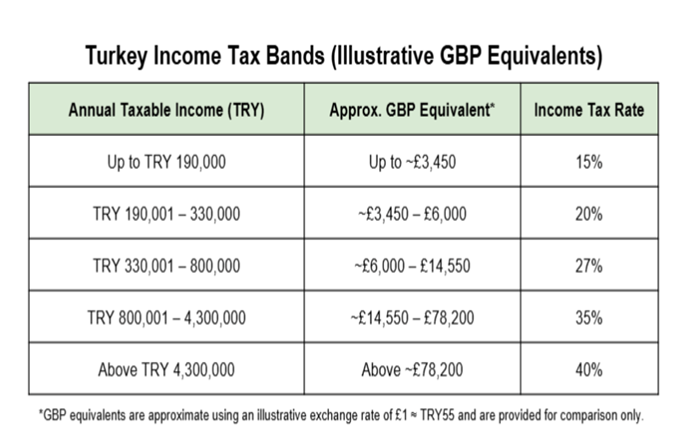
Employment income, business profits, rental income and certain investment income may all be taxed under these rates where they arise in Turkey. However, qualifying foreign income may instead benefit from the new 20-year exemption, making the source of the income just as important as the applicable tax rate.
Although numerous Turkey tax calculators are available online, they rarely take account of tax residency, treaty relief, exempt foreign income or cross-border planning. For UK expats, calculating the correct tax position often requires considerably more than applying the published tax bands.
How the UK–Turkey Double Tax Treaty Works
The UK–Turkey Double Tax Treaty is designed to prevent the same income from being taxed twice. It determines which country has the primary right to tax different types of income and allows relief where tax has already been paid in the other jurisdiction.
The full treaty is available on the UK Government’s legislation website and should be reviewed alongside the new Turkish tax legislation before changing tax residency.
The treaty becomes particularly important if both the UK and Turkey consider you tax resident. In these circumstances, a series of tie-breaker rules determines where you are treaty resident by considering your permanent home, your centre of vital interests, your habitual abode and, if necessary, your nationality.
If the position still cannot be resolved, the UK and Turkish tax authorities must determine your residence by mutual agreement.
The treaty also contains specific provisions covering dividends, interest, private pensions and government pensions. While the new 20-year exemption may remove Turkish tax on qualifying foreign income, the treaty continues to determine whether the UK retains taxing rights and whether foreign tax credits are available.
Changing tax residency without understanding the UK–Turkey Double Tax Treaty can be an expensive mistake.
The greatest tax savings are usually achieved before your tax residency changes—not afterwards.
Get Your Treaty Position Right
The UK–Turkey Double Tax Treaty can significantly affect how your pensions, investments and other income are taxed. Getting it wrong could mean paying more tax than necessary—or in some cases, paying tax twice.
We will help you:
- Determine where you are tax resident.
- Apply the treaty correctly.
- Protect your tax position before you relocate.
Book Your UK–Turkey Tax Review
Limited private strategy slots available each week.
Trusted by UK nationals globally.
Prefer to speak directly? Tel: +44 208 058 8937.
Email: connect@adviceforexpats.com.
How UK Pensions Are Taxed in Turkey
For many UK expats, pensions are their largest source of retirement income, making international pension planning one of the most important considerations before relocating.
Under the UK–Turkey Double Tax Treaty, private pensions—including workplace pensions, personal pensions, SIPPs and annuities—are generally taxable in the country where you are treaty resident. Turkey’s new 20-year foreign income tax exemption could therefore remove Turkish tax on qualifying foreign pension income for up to 20 years.
Government-service pensions are different and are generally treated separately under the UK–Turkey Double Tax Treaty. Identifying the type of pension you hold before relocating could significantly increase your after-tax retirement income.

Tax on Dividends, Investments and Capital Gains
One of the biggest attractions of Turkey’s new regime is that qualifying foreign dividends, interest, investment income and capital gains may be exempt from Turkey tax for up to 20 years.
The exemption applies only to qualifying foreign-source income. Dividends from Turkish companies, Turkish bank interest and gains arising from Turkish investments continue to be taxed under the normal Turkish rules.
The bank account is largely irrelevant. Where the income actually arises determines how Turkey taxes it. A UK investment portfolio may qualify for the exemption, whereas an identical investment in Turkey generally will not.
UK nationals should also remember that moving to Turkey does not automatically remove UK tax liabilities. UK property gains and certain temporary non-residence rules may still apply after leaving Britain.
Property Tax, Rental Income and Turkish Citizenship by Investment
Turkey’s new tax regime and investing in property in Turkey are separate. Purchasing qualifying property or obtaining Turkish citizenship does not automatically make you a Turkish tax resident.
The current citizenship by investment programme requires a minimum qualifying property investment of US$400,000, with the property normally retained for at least three years.
Rental income from Turkish property remains taxable because it is Turkish-source income and does not qualify for the 20-year tax exemption. By contrast, qualifying rental income from property located outside Turkey may benefit from the exemption.
Buying property in Turkey and becoming a Turkish tax resident are two very different decisions—and each should be planned separately. Gains on qualifying foreign assets may fall within the new regime, whereas gains on Turkish property continue to be taxed under the existing Turkish rules.
Corporate Tax and Business Owners Moving to Turkey
The 20-year exemption applies to the individual, not automatically to the company they own.
Turkey’s standard corporate tax rate is 25%, increasing to 30% for certain financial institutions. A foreign company may also become subject to Turkish taxation if it creates a permanent establishment or if its effective management is transferred to Turkey.
Moving yourself to Turkey is straightforward. Moving your business without creating unexpected tax liabilities is often far more complex. Simply invoicing through a UK company does not necessarily make the income foreign-source if the work is carried out from Turkey.
Warning: For business owners, separating personal tax residency from corporate tax residency is essential. A shareholder may qualify for the 20-year exemption while the company itself remains fully taxable under Turkish corporate tax rules.
UK vs Turkey Tax Comparison
For UK expats, the decisive difference is no longer the headline income-tax rate. It is the treatment of foreign income after becoming tax resident.
UK residents are generally taxed on worldwide income. By contrast, qualifying new Turkish tax residents may receive foreign pensions, dividends, interest, rental income and capital gains free from Turkish tax for up to 20 years.
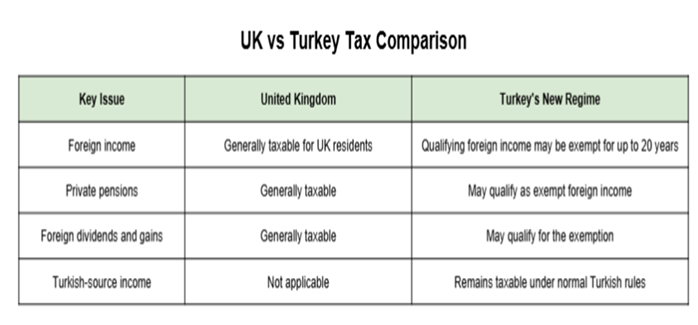
This is the real attraction of the new regime: it may allow UK expats to become fully tax resident in Turkey without exposing qualifying foreign wealth and income to normal Turkish taxation.
Find Out Whether Turkey Is Right for You
Turkey’s new tax regime could be transformational—but only if it aligns with your personal circumstances, assets and long-term objectives.
We will help you:
- Compare Turkey with your current tax position.
- Assess your potential tax savings.
- Build a tax-efficient relocation strategy.
Book Your International Tax Strategy Consultation
Limited private strategy slots available each week.
Trusted by UK nationals globally.
Prefer to speak directly? Tel: +44 208 058 8937.
Email: connect@adviceforexpats.com.
Common Tax Planning Mistakes UK Expats Make
Most costly tax mistakes occur before relocating, not afterwards.
One of the most common errors is assuming that obtaining Turkish residency or citizenship automatically qualifies you for the 20-year exemption. Others mistakenly believe that all foreign income becomes tax-free or that purchasing property in Turkey automatically creates tax residency.
Business owners frequently overlook the corporate tax implications of managing a UK company from Turkey, while UK retirees often assume every UK pension is taxed in the same way. Investors can also create unnecessary tax exposure by disposing of assets after, rather than before, changing tax residency.
The biggest tax mistakes are rarely made after relocating—they are usually made before you leave the UK.
Why Professional Tax Planning Matters
Turkey’s new tax regime creates significant opportunities, but only if supported by specialist tax planning for UK expats before becoming a Turkey tax resident.
The interaction between Turkish tax law, the UK–Turkey Double Tax Treaty, UK residence rules and the treatment of pensions, investments and business interests means there is rarely a one-size-fits-all solution. The sequence of events can be just as important as the decisions themselves.
Every major financial decision made before becoming a Turkish tax resident has the potential to affect your tax position for decades.

Why Choose Advice for Expats
Relocating to Turkey involves far more than understanding Turkish tax law. It requires coordinated financial planning across two jurisdictions, ensuring your tax residency, pensions, investments, property ownership and long-term financial affairs work together rather than against each other.
Unlike local advisers who typically focus on Turkish legislation, Advice for Expats specialises exclusively in helping UK nationals relocate overseas. We understand both the UK and Turkish tax systems, enabling us to identify tax planning opportunities, minimise cross-border tax exposure and coordinate with the specialists that can deliver a seamless relocation.
The greatest planning opportunities exist before your tax residency changes. Once you relocate, some opportunities may no longer be available. We help UK nationals structure their move at the point where the biggest long-term tax savings can often still be secured.
Frequently Asked Questions: Turkey’s 20-year foreign income tax exemption
Below are answers to some of the most common questions UK nationals ask about Turkey’s new tax regime and relocating to Turkey.
Can I lose Turkey’s 20-year foreign income tax exemption?
Yes. The exemption depends on meeting the qualifying conditions and continuing to comply with Turkish tax requirements. Incorrect reporting, changes in residency status or failure to satisfy the legislation could affect your entitlement. Eligibility should be confirmed before relocating and reviewed throughout the exemption period.
Does the 20-year tax exemption apply to UK rental income?
Potentially. Rental income from property located outside Turkey may qualify as exempt foreign-source income. However, rent from UK property remains taxable in the UK, even where Turkey does not tax it. The UK–Turkey Double Tax Treaty determines how any overlapping liabilities are relieved.
Does Turkish Citizenship by Investment qualify me for the tax exemption?
No. Turkish citizenship, property ownership and tax residency are separate. Obtaining citizenship through the US$400,000 property route does not automatically qualify you for the 20-year foreign income exemption. You must independently satisfy the tax residency and eligibility conditions.
Can I keep my UK company after moving to Turkey?
Yes. However, managing the company from Turkey may create Turkish corporate tax exposure if effective management moves there or a permanent establishment is created. Company ownership alone is not the issue; where strategic decisions and business activities take place is what matters.
Is Turkey one of the most tax-efficient countries for UK expats?
For qualifying individuals, potentially. The 20-year exemption can shelter foreign pensions, dividends, interest, rental income and capital gains from Turkish tax. However, Turkish-source income remains taxable, so the overall benefit depends on where your income arises and how your affairs are structured.
People Also Ask: Turkey’s 20-year foreign income tax exemption
These are frequently searched questions about tax in Turkey, answered briefly and directly.
Is foreign income taxable in Turkey?
Not always. Qualifying new Turkish tax residents may receive certain foreign pensions, dividends, interest, rental income and capital gains free from Turkish tax for up to 20 years. Income arising in Turkey generally remains taxable under the normal domestic rules.
Does Turkey tax UK pensions?
It depends on the pension. Qualifying private UK pensions may benefit from Turkey’s 20-year foreign income exemption. UK government-service pensions are treated differently under the UK–Turkey Double Tax Treaty and may remain taxable in the United Kingdom.
Does buying property in Turkey make you tax resident?
No. Buying property in Turkey does not automatically make you a Turkish tax resident. Property ownership, residence permits, citizenship and tax residency are separate. However, rental income and gains arising from Turkish property remain taxable in Turkey.
How do I become a Turkish tax resident?
You generally become tax resident by establishing your settled home in Turkey or spending more than six months there during a calendar year. If both Turkey and the UK claim residence, the UK–Turkey Double Tax Treaty applies tie-breaker rules.
Can I reduce UK tax by moving to Turkey?
Potentially. Becoming non-UK resident and qualifying for Turkey’s foreign income exemption may reduce tax on pensions, investments and overseas income. However, some UK income and gains remain taxable after departure, so planning must take place before residency changes.
Is Turkey a good country for UK retirees?
For many UK retirees, yes. Turkey offers relatively low living costs, established private healthcare, a warm climate and a potentially favourable tax regime for qualifying foreign pension income. The financial benefit depends on pension type, residency status and individual circumstances.
Useful Resources
The following resources provide additional official information for UK nationals considering Turkish tax residency.
OECD: Türkiye Country Profile: Economic analysis, policy reports and international taxation insights relating to Türkiye.
International tax residency guidance: Official guidance on international tax residency, dual residence and cross-border tax compliance.
Türkiye tax administration report: Independent overview of Türkiye’s tax administration, compliance framework and international tax standards.
Start Your Turkey Tax Planning Journey
Turkey’s new 20-year foreign income tax exemption represents one of the most significant international tax opportunities available to UK expats, retirees, entrepreneurs and internationally mobile investors. However, the greatest benefits are usually secured before you become a Turkey tax resident.
Whether you are planning to retire in Turkey, relocate your business, invest in Turkish property or obtain Turkish Citizenship by Investment, early planning can make a significant difference to your long-term tax position.
If you are considering relocating, now is the time to review your circumstances, assess your eligibility and develop a tax-efficient strategy tailored to your objectives.
Don’t Leave Your Tax Position to Chance
One decision made before relocating could affect your tax position for the next 20 years.
- Confirm your eligibility.
- Identify tax risks before you move.
- Secure the full benefit of Turkey’s new tax regime.
Book Your Turkey Tax Strategy Consultation
Limited private strategy slots available each week.
Trusted by UK nationals globally.
Prefer to speak directly? Tel: +44 208 058 8937.
Email: connect@adviceforexpats.com.